
Crafting Effective Complaint Letters: Your 2026 Guide to Resolution
In an increasingly complex world of products, services, and digital interactions, instances of dissatisfaction are almost inevitable. While a quick phone call or an online chat might resolve minor issues, there are times when a more formal and structured approach is required. This is where the power of an effective complaint letter guide comes into play. A well-crafted complaint letter isn’t just a vent; it’s a strategic tool designed to clearly articulate your issue, present your case, and solicit a satisfactory resolution. It’s a testament to your professionalism and your commitment to fair treatment.
This comprehensive 2026 guide will walk you through everything you need to know about writing a complaint letter that gets results. We’ll cover the essential elements, provide a step-by-step approach, discuss crucial considerations for tone and content, and even offer a customizable template to ensure your next complaint is both impactful and successful. Whether you’re dealing with a faulty product, unsatisfactory service, or a billing error, mastering the art of the complaint letter is an invaluable skill for any consumer.
Why a Formal Complaint Letter Still Matters in 2026
In an era dominated by social media rants and instant messaging, some might question the relevance of a formal complaint letter. However, its importance remains undiminished, especially for significant issues. Here’s why:
- Formal Record: A written letter creates a documented record of your complaint, the date it was sent, and the details of the issue. This is crucial if further action, such as legal intervention, becomes necessary.
- Clarity and Precision: Unlike a hurried phone call, a letter allows you to carefully articulate your problem, organize your thoughts, and present evidence without interruption. This clarity significantly increases the chances of understanding and resolution.
- Professionalism: A well-written letter conveys professionalism and seriousness. It signals to the recipient that you are taking the matter seriously and expect a thoughtful response.
- Escalation Potential: If your initial attempts at resolution fail, a formal complaint letter serves as a crucial step before escalating the issue to higher management, regulatory bodies, or consumer protection agencies.
- Emotional Detachment: Writing allows for a more objective presentation of facts, minimizing emotional language that can often detract from the core issue during verbal communication.
Understanding the enduring value of this communication method is the first step in effectively using our complaint letter guide to your advantage.
Anúncios
Key Elements of an Effective Complaint Letter
Every impactful complaint letter shares several core components. Missing even one can weaken your case and delay resolution. Let’s break down these essential elements:
1. Your Contact Information and the Date
Always start with your full name, address, phone number, and email address. Below that, include the current date. This ensures the recipient knows who you are and how to reach you.
2. Recipient’s Contact Information
Address the letter to the correct person or department. If you don’t have a specific name, use a title like “Customer Service Manager” or “Head of Complaints Department.” Researching the appropriate contact can significantly speed up the resolution process.
3. A Clear and Concise Subject Line
This is paramount. Your subject line should immediately inform the recipient of the letter’s purpose. For example: “Complaint Regarding Faulty Product – Order #12345” or “Unsatisfactory Service Experience on [Date] – Account #67890.” A good subject line helps in routing your letter to the right place quickly.
4. Salutation
Use a professional salutation, such as “Dear Mr./Ms. [Last Name]” or “To Whom It May Concern” if a specific name is unavailable.
5. Opening Statement: State the Purpose Directly
Get straight to the point. Clearly state that you are writing to complain about a specific issue. This sets the tone for the rest of the letter and immediately informs the reader of its intent. For example: “I am writing to express my strong dissatisfaction with [product/service] received on [date].”
6. Detailed Explanation of the Problem
This is the core of your letter. Provide a factual, chronological account of what happened. Include specific dates, times, locations, and names of individuals involved, if applicable. Avoid emotional language; stick to the facts. The more detailed and objective you are, the stronger your case will be. For instance, instead of saying “The product broke immediately,” say “The [product name] (Serial Number: XXX) stopped functioning within 24 hours of purchase on [date], despite following all operating instructions.”
7. Supporting Evidence (Mention, but don’t necessarily include in the first letter)
Refer to any supporting documents you have, such as receipts, warranties, contracts, photographs, emails, or call logs. While you might not attach them to your initial email or letter (unless explicitly requested or if it’s a physical letter), mentioning their existence demonstrates you have proof. You can state: “I have attached copies of my receipt and relevant photographs for your review.”
8. State Your Desired Resolution
What do you want to happen? Be clear and realistic. Do you want a refund, a replacement, a repair, a credit, or an apology? Clearly articulating your desired outcome guides the recipient towards a solution. This is a critical component of any effective complaint letter guide.
Anúncios
9. Call to Action and Timeframe
Specify what action you expect and by when. For example: “I expect a full refund within 14 business days” or “Please contact me to arrange for a repair within one week.” Providing a reasonable timeframe encourages prompt action.
10. Closing Statement
Maintain a professional and firm tone. You can reiterate your expectation for a prompt resolution. For example: “I look forward to your prompt response and a satisfactory resolution to this matter.”
11. Professional Closing
Use a formal closing such as “Sincerely,” or “Respectfully,” followed by your full name and signature (if it’s a physical letter).
Step-by-Step Guide to Writing Your Complaint Letter
Now that you understand the essential elements, let’s put it all together into a practical, step-by-step process for crafting your complaint letter.
Step 1: Gather All Relevant Information and Documentation
Before you even begin writing, collect everything pertinent to your complaint. This includes purchase receipts, order numbers, warranty information, dates of interactions, names of employees, photographs, screenshots, and any previous correspondence. Organizing this information upfront will make the writing process much smoother and ensure you don’t miss crucial details.
Step 2: Identify the Right Recipient
As mentioned, sending your letter to the correct person or department is vital. Check the company’s website for a customer service or complaints section. If you can’t find a specific name, a general department title is acceptable. Avoid sending it to a generic [email protected] address if a more specific one is available.
Step 3: Draft a Clear and Concise Subject Line
Spend a moment on this. A good subject line is like a headline – it grabs attention and summarizes the content. Make it specific and include any relevant identifiers (e.g., account number, order ID).
Step 4: Write a Professional Opening
Start with your contact information, the date, and the recipient’s contact information. Then, use a polite but firm salutation. Immediately state the purpose of your letter.
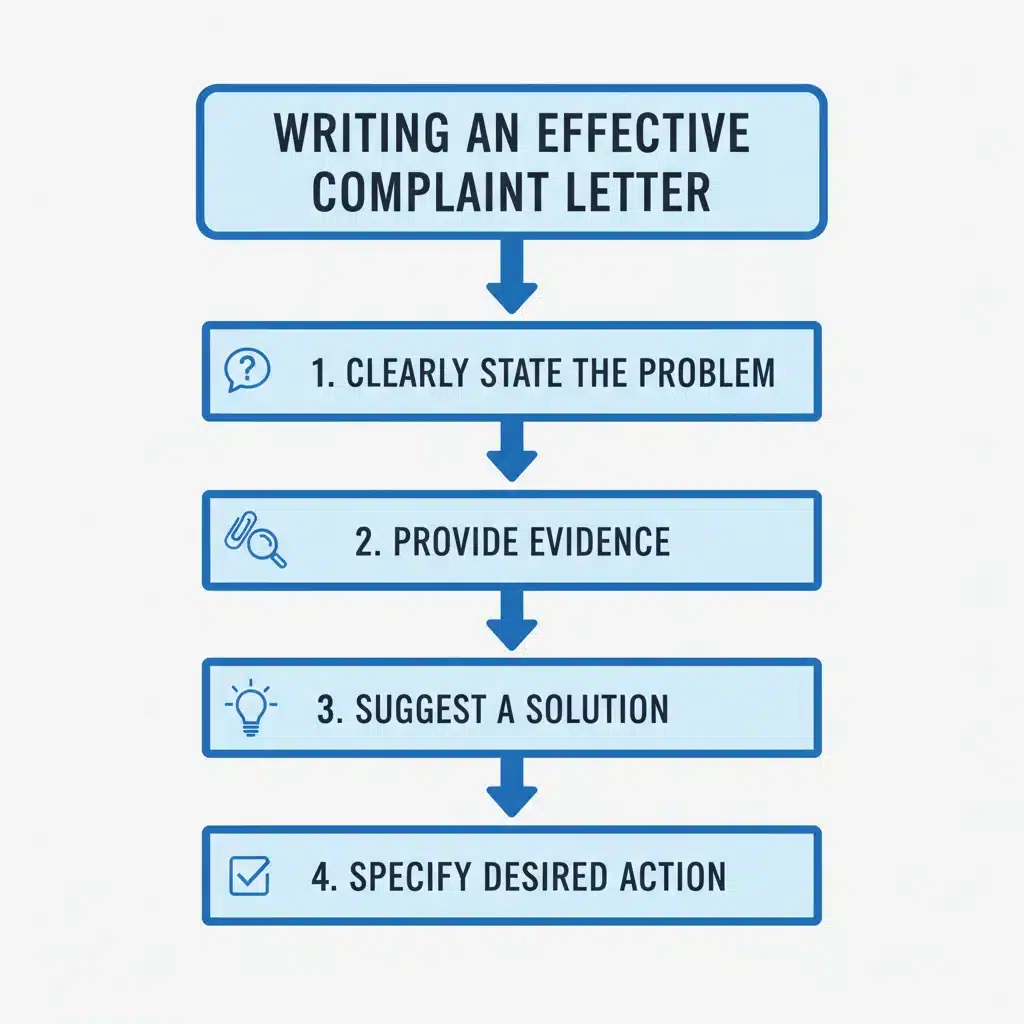
Step 5: Detail the Problem Factually and Chronologically
This is where your gathered information comes into play. Describe the issue clearly, providing specific dates, times, and events. Focus on facts rather than emotions. Quantify the problem if possible (e.g., “The product failed after only 3 uses,” “I was charged an incorrect amount of $X”).
Step 6: Refer to Supporting Documents
Mention that you have supporting documentation and are prepared to provide it. If sending an email, you can attach them directly. If a physical letter, state that copies are enclosed and keep originals for your records.
Step 7: Clearly State Your Desired Resolution
What do you consider a fair outcome? Be specific. If you want a refund, state the exact amount. If a replacement, specify the product. If a service, what kind of service are you looking for? A well-defined resolution is a hallmark of an effective complaint letter guide.
Step 8: Set a Reasonable Deadline for Response
Give the company a realistic timeframe to respond and resolve the issue (e.g., 7-14 business days). This demonstrates your seriousness and provides a benchmark for follow-up.
Step 9: Conclude Professionally
End your letter with a professional closing and your full name. If mailing, sign above your typed name.
Step 10: Proofread and Review
Before sending, meticulously proofread your letter for any grammatical errors, typos, or factual inaccuracies. A polished letter reinforces your professionalism and ensures your message is taken seriously. Read it aloud to catch awkward phrasing.
Tone and Language: Striking the Right Balance
The tone of your complaint letter is almost as important as its content. While you may be frustrated, an angry or aggressive tone can be counterproductive. Aim for a tone that is:
- Professional: Use formal language. Avoid slang, jargon, or overly casual expressions.
- Assertive, Not Aggressive: Clearly state your position and expectations without resorting to threats or emotional outbursts.
- Objective and Factual: Stick to the verifiable facts of the situation. Describe what happened, not how it made you feel.
- Polite (Initially): While firm, beginning with a polite opening can encourage a more receptive response.
- Clear and Concise: Avoid lengthy, rambling sentences. Get to the point efficiently.
Remember, your goal is resolution, not retribution. A calm, well-reasoned argument is far more likely to achieve your desired outcome than an emotional tirade. This principle is central to any valuable complaint letter guide.
When to Escalate Your Complaint
Sometimes, despite your best efforts with a well-written complaint letter, you might not receive a satisfactory response. Knowing when and how to escalate is crucial.
- No Response within Timeframe: If the company fails to respond within the deadline you provided, it’s time to follow up.
- Unsatisfactory Response: If the proposed solution doesn’t meet your reasonable expectations, you have grounds to escalate.
- Repeated Issues: If the same problem recurs after a supposed resolution, further action is warranted.
How to Escalate:
- Follow-up Letter/Email: Send a polite follow-up, referencing your original complaint and the lack of satisfactory resolution. Reiterate your desired outcome.
- Higher Management: If the initial contact doesn’t resolve the issue, seek out contact information for higher-level management or the CEO’s office.
- Consumer Protection Agencies: Depending on the nature of your complaint and your location, government consumer protection agencies (e.g., Federal Trade Commission, Better Business Bureau, local consumer affairs offices) can be valuable resources.
- Industry Regulators: Certain industries (e.g., banking, telecommunications, insurance) have specific regulatory bodies that oversee consumer complaints.
- Legal Counsel: As a last resort for significant issues, consulting an attorney may be necessary.
Complaint Letter Template (2026 Edition)
Here’s a customizable template to help you structure your complaint letter effectively. Remember to fill in the bracketed information with your specific details.
[Your Name]
[Your Address]
[Your City, Postal Code]
[Your Phone Number]
[Your Email Address]

[Date]

[Recipient Name/Title (e.g., Customer Service Manager)]
[Company Name]
[Company Address]
[Company City, Postal Code]

Subject: Formal Complaint Regarding [Briefly State Issue, e.g., Faulty Product / Unsatisfactory Service] - [Relevant Account/Order Number]

Dear [Mr./Ms./Mx. Last Name or To Whom It May Concern],

I am writing to formally express my dissatisfaction with [product name/service received] on [date of purchase/service] at [location of purchase/service, if applicable]. My [account number/order number/invoice number] is [number].

Specifically, the problem I encountered was [clearly and factually describe the problem. Be specific about what happened, when, and any individuals involved. Provide a chronological account if necessary. Avoid emotional language.]. For example:

- "The [product name] (Serial Number: [Serial Number]) stopped functioning correctly on [date] despite following all operating instructions. The specific malfunction is [describe malfunction]."
- "During my service appointment on [date] at [time], [employee name, if known] provided unsatisfactory service by [describe specific actions or inactions]."
- "My bill for [billing period] included an incorrect charge of [amount] for [reason for charge]. I believe this charge is erroneous because [explain why]."

I have attached/have available for your review copies of [list relevant documents, e.g., my receipt, warranty, photographs, correspondence, screenshots] to support my claim.

To resolve this issue, I request [clearly state your desired resolution, e.g., a full refund of [amount], a replacement of the product, a repair of the item, a credit to my account, an apology and explanation].

I expect a response and a satisfactory resolution to this matter within [state a reasonable timeframe, e.g., 10 business days] from the date of this letter. If I do not receive a resolution within this timeframe, I will consider escalating my complaint to [mention next step, e.g., higher management, consumer protection agencies].

Thank you for your prompt attention to this important matter. I look forward to your timely response.

Sincerely,

[Your Full Name]
[Your Signature (for physical letters)]
Additional Tips for Maximizing Your Complaint Letter’s Effectiveness
Beyond the structure, a few extra considerations can further enhance the impact of your complaint letter:
- Keep a Copy: Always retain a copy of the letter you send, along with any supporting documents. This is your personal record of the communication.
- Send by Certified Mail (for physical letters): If sending a physical letter, consider using certified mail with a return receipt requested. This provides proof that the letter was sent and received. For emails, request a read receipt.
- Be Prepared to Negotiate: While you should state your desired resolution, be open to reasonable alternatives. The company might offer a different solution that is still acceptable to you.
- Maintain a Paper Trail: Document all interactions, including phone calls, emails, and follow-up letters. Note down dates, times, names of people you spoke with, and a summary of the conversation.
- Know Your Rights: Familiarize yourself with consumer protection laws in your region. Understanding your rights can strengthen your position and guide your expectations for a resolution.
- Avoid ultimatums (initially): While it’s good to state next steps if unresolved, avoid aggressive ultimatums in your initial letter. Focus on problem-solving.
Common Mistakes to Avoid
Even with a solid complaint letter guide, it’s easy to fall into common pitfalls. Be sure to avoid these:
- Being Vague: “I’m unhappy with your service” is not helpful. “The internet service was out for 72 hours from Tuesday, October 10th at 3 PM to Friday, October 13th at 3 PM, despite multiple calls to your support line” is.
- Emotional Outbursts: Yelling, swearing, or using aggressive language will only alienate the recipient and make them less inclined to help.
- Threats (Prematurely): While you might eventually consider legal action, making threats in your initial letter is generally counterproductive. Focus on resolution first.
- Lack of Documentation: Sending a complaint without any supporting evidence weakens your case significantly.
- Unrealistic Expectations: Demanding a full refund for a minor inconvenience might be seen as unreasonable. Your desired resolution should be proportionate to the problem.
- Ignoring Company Procedures: Some companies have specific complaint procedures. While a formal letter is always good, try to adhere to their initial steps if they are reasonable.
- Delaying Too Long: The longer you wait to complain, the harder it can be to gather evidence and for the company to investigate. Act promptly.
- Sending to the Wrong Department: This wastes time and can frustrate both you and the company. Always try to find the most appropriate contact.
Conclusion: Empowering Your Consumer Voice
In conclusion, mastering the art of the complaint letter is an essential skill for any discerning consumer. It empowers you to advocate for yourself effectively, ensuring that your concerns are heard and addressed appropriately. By following this complaint letter guide, you can transform your frustration into a structured, professional, and ultimately successful communication. Remember, a well-written letter is a powerful tool for achieving fair treatment and resolution in the marketplace of 2026 and beyond. Don’t underestimate its impact; use it wisely to protect your rights and ensure satisfaction.
Equipped with this knowledge and our adaptable template, you are now ready to tackle any consumer issue with confidence and clarity. Your voice matters, and a well-crafted complaint letter ensures it is heard loud and clear.