Decoding Service Agreements: 7 Crucial Clauses to Scrutinize Before Signing

Anúncios
Decoding Service Agreements: 7 Crucial Clauses to Scrutinize Before Signing
In the dynamic world of business, service agreements are the bedrock upon which successful collaborations are built. Whether you’re a freelancer, a small business owner, or a large corporation, entering into a service agreement is an almost inevitable part of operations. These legally binding documents outline the terms and conditions under which services will be provided, defining responsibilities, expectations, and remedies. However, the sheer volume of legal jargon and intricate details can often make these agreements daunting to navigate. Many individuals and businesses sign on the dotted line without fully comprehending the implications of each clause, leading to potential disputes, financial losses, and damaged professional relationships down the line. This is precisely why a thorough understanding of the most critical service agreement clauses is not just advisable, but absolutely essential.
This comprehensive guide aims to demystify the complexities of service agreements by focusing on seven crucial service agreement clauses that demand your utmost attention before you commit. We’ll delve into each clause, explaining its purpose, potential pitfalls, and what you should look for to protect your interests. By the end of this article, you’ll be equipped with the knowledge to approach any service agreement with confidence, ensuring clarity, fairness, and a solid foundation for your business endeavors.
1. Scope of Services: Defining Expectations Clearly
The ‘Scope of Services’ clause is arguably the most fundamental component of any service agreement. It meticulously details the specific services to be rendered by the service provider. Without a clear and unambiguous definition, both parties are left vulnerable to misunderstandings and disagreements regarding what constitutes satisfactory performance. Imagine hiring a marketing agency without a precise outline of deliverables; you might expect a full social media campaign, while they might only plan for content creation. Such discrepancies can quickly escalate into costly disputes.
Anúncios
What to look for:
- Specificity: Ensure the services are described with the highest level of detail. Avoid vague language. Instead of ‘marketing services,’ specify ‘development of a 3-month social media content calendar, 15 posts per week across Facebook and Instagram, and monthly performance reports.’
- Deliverables: Clearly list all tangible outputs or results expected. Are there reports, designs, software modules, or specific project milestones?
- Exclusions: Just as important as what is included, clearly state what is NOT included. This helps manage expectations and prevents ‘scope creep,’ where additional work is requested without corresponding compensation.
- Measurement of Success: If possible, define metrics or key performance indicators (KPIs) that will be used to evaluate the success of the services. This provides an objective standard for performance.
- Change Management Process: Acknowledge that project requirements can evolve. The clause should outline a formal process for requesting, approving, and pricing any changes to the scope of work. This is one of the most critical aspects to prevent future headaches related to the service agreement clauses.
A well-defined ‘Scope of Services’ clause acts as a blueprint for the entire engagement, setting realistic expectations and minimizing the potential for conflict. It’s the first line of defense against ambiguity and a cornerstone of successful service delivery.
2. Payment Terms and Schedule: Ensuring Financial Clarity
Money matters are often the most contentious in any business relationship. The ‘Payment Terms and Schedule’ clause dictates how and when the service provider will be compensated. Ambiguity here can lead to delayed payments, cash flow issues, and strained relationships. Both parties need to be absolutely clear on the financial arrangements before any work commences.
What to look for:
- Total Cost: Clearly state the total agreed-upon cost for the services. If it’s an hourly rate, specify the rate and an estimated total or cap.
- Payment Milestones: For larger projects, payments are often tied to specific project milestones or deliverables. Clearly define these milestones and the corresponding payment amounts.
- Payment Due Dates: Specify exact due dates for each payment. For example, ‘payment due within 30 days of invoice receipt.’
- Payment Methods: Outline acceptable payment methods (e.g., bank transfer, credit card, check).
- Late Payment Penalties: What happens if a payment is late? Include provisions for late fees or interest charges to incentivize timely payments. This is a vital deterrent and a protective measure within the service agreement clauses.
- Invoicing Procedures: Detail how invoices will be submitted, what information they must contain, and to whom they should be sent.
- Expenses: If the service provider will incur expenses (travel, materials, software licenses) that will be reimbursed, clearly define which expenses are covered, how they should be documented, and any limits.
- Refund Policy: Under what circumstances, if any, are refunds applicable?
A robust ‘Payment Terms and Schedule’ clause ensures that financial expectations are aligned, promoting smooth transactions and preventing disputes over compensation. It’s one of the non-negotiable service agreement clauses.
3. Term and Termination: Understanding the Beginning, Middle, and End
Every agreement has a beginning and an end. The ‘Term and Termination’ clause defines the duration of the agreement and the conditions under which either party can end it prematurely. This clause is critical for providing an exit strategy and preventing indefinite commitments or abrupt, damaging departures.
What to look for:
- Start and End Dates: Clearly state the effective date of the agreement and its scheduled end date.
- Renewal Options: Does the agreement automatically renew? If so, under what terms and for how long? Is there an option for either party to prevent renewal?
- Termination for Cause: Define specific events that would allow one party to terminate the agreement due to the other’s breach. Examples include failure to meet deliverables, non-payment, or violation of confidentiality.
- Notice Period for Termination: Specify the required notice period for termination, both for cause and for convenience (if allowed). This gives both parties time to prepare for the end of the relationship.
- Termination for Convenience: Does either party have the right to terminate the agreement without cause? If so, what are the conditions? This often involves a specified notice period and potentially a termination fee to compensate for lost work.
- Post-Termination Obligations: What happens after termination? This includes return of property, payment for services rendered up to the termination date, data handover, and continued confidentiality obligations. These are vital considerations within the service agreement clauses.
Careful attention to this clause can save you from being locked into an unfavorable agreement or facing unexpected liabilities upon termination. It’s about ensuring a graceful exit strategy for all parties involved.

Anúncios
4. Intellectual Property Rights: Who Owns What?
In today’s knowledge economy, intellectual property (IP) is often a company’s most valuable asset. The ‘Intellectual Property Rights’ clause determines who owns the creations, innovations, and content produced during the course of the service engagement. Misunderstanding this clause can lead to significant legal battles and loss of valuable assets.
What to look for:
- Ownership of Deliverables: Does the client automatically own all work products created by the service provider upon full payment? Or does the service provider retain ownership and grant the client a license to use the work? This is a fundamental distinction.
- Assignment of Rights: If the client is to own the IP, ensure there is a clear ‘assignment’ clause stating that the service provider assigns all rights, title, and interest in the deliverables to the client.
- Pre-existing IP: What about any pre-existing IP that the service provider brings to the project? How will it be used, and who retains ownership of it?
- Licenses: If the service provider retains ownership, what kind of license is granted to the client? Is it exclusive, non-exclusive, perpetual, revocable, worldwide? The scope of the license is crucial.
- Warranties regarding IP: The service provider should warrant that the deliverables do not infringe on the intellectual property rights of any third party.
- Indemnification: Who is responsible if a third party claims IP infringement? This should be clearly addressed. This is one of the most complex service agreement clauses and often requires legal counsel.
Clarifying IP ownership from the outset prevents future disputes and ensures that both parties understand their rights and obligations concerning creative output. It’s a critical element of modern service agreement clauses.
5. Confidentiality and Non-Disclosure: Protecting Sensitive Information
Many service engagements involve the exchange of sensitive information, such as trade secrets, client lists, business strategies, or proprietary technology. The ‘Confidentiality and Non-Disclosure’ clause is designed to protect this information from unauthorized disclosure or use. Breaching this clause can have severe legal and financial repercussions.
What to look for:
- Definition of Confidential Information: Clearly define what constitutes confidential information. This should be broad enough to cover various types of data but specific enough to be enforceable.
- Obligations of the Receiving Party: Outline how the receiving party must handle confidential information, including restricting access, preventing unauthorized disclosure, and using it only for the purposes of the agreement.
- Exclusions from Confidentiality: Specify what information is NOT considered confidential (e.g., information already publicly known, information independently developed, or information legally required to be disclosed).
- Duration of Confidentiality: Confidentiality obligations often extend beyond the termination of the agreement. Specify how long this obligation lasts (e.g., 2 years, 5 years, indefinitely for trade secrets).
- Return or Destruction of Information: What happens to confidential information upon termination? It should be returned or destroyed, with certification of destruction.
- Remedies for Breach: While often implied, stating the potential remedies for a breach (e.g., injunctive relief, monetary damages) can serve as a strong deterrent. This is a particularly sensitive area within the service agreement clauses.
A robust confidentiality clause builds trust and provides a legal framework for protecting invaluable business secrets. It’s an indispensable component of most service agreement clauses.
6. Indemnification and Limitation of Liability: Allocating Risk
Accidents happen, mistakes are made, and things don’t always go as planned. The ‘Indemnification and Limitation of Liability’ clause determines who bears the financial responsibility for certain risks, damages, or legal claims arising from the service engagement. This is one of the most heavily negotiated service agreement clauses because it directly impacts financial exposure.
What to look for:
- Indemnification Clause: This clause typically states that one party (the indemnifying party) will compensate the other party (the indemnified party) for specific losses, damages, or legal expenses incurred due to the indemnifying party’s actions or omissions. For example, a service provider might indemnify a client against claims arising from the service provider’s negligence or infringement of third-party IP.
- Scope of Indemnification: What specific types of claims are covered? Is it limited to third-party claims, or does it include claims between the parties?
- Limitation of Liability: This clause seeks to cap the amount of damages one party can claim from the other in the event of a breach or other liability. Common caps include the total fees paid under the agreement, a multiple of the fees, or a specific monetary amount.
- Exclusions from Liability: Certain types of damages are often excluded, such as indirect, consequential, punitive, or special damages, as well as lost profits or data.
- Gross Negligence/Willful Misconduct: Often, limitations of liability do not apply in cases of gross negligence, willful misconduct, or fraud. Ensure these exceptions are clearly defined.
- Mutual vs. Unilateral Indemnification: Is the indemnification reciprocal (both parties indemnify each other) or unilateral (only one party indemnifies the other)?
Understanding and negotiating these service agreement clauses is crucial for managing risk and protecting your financial health. Seek legal counsel if you are unsure about the implications.
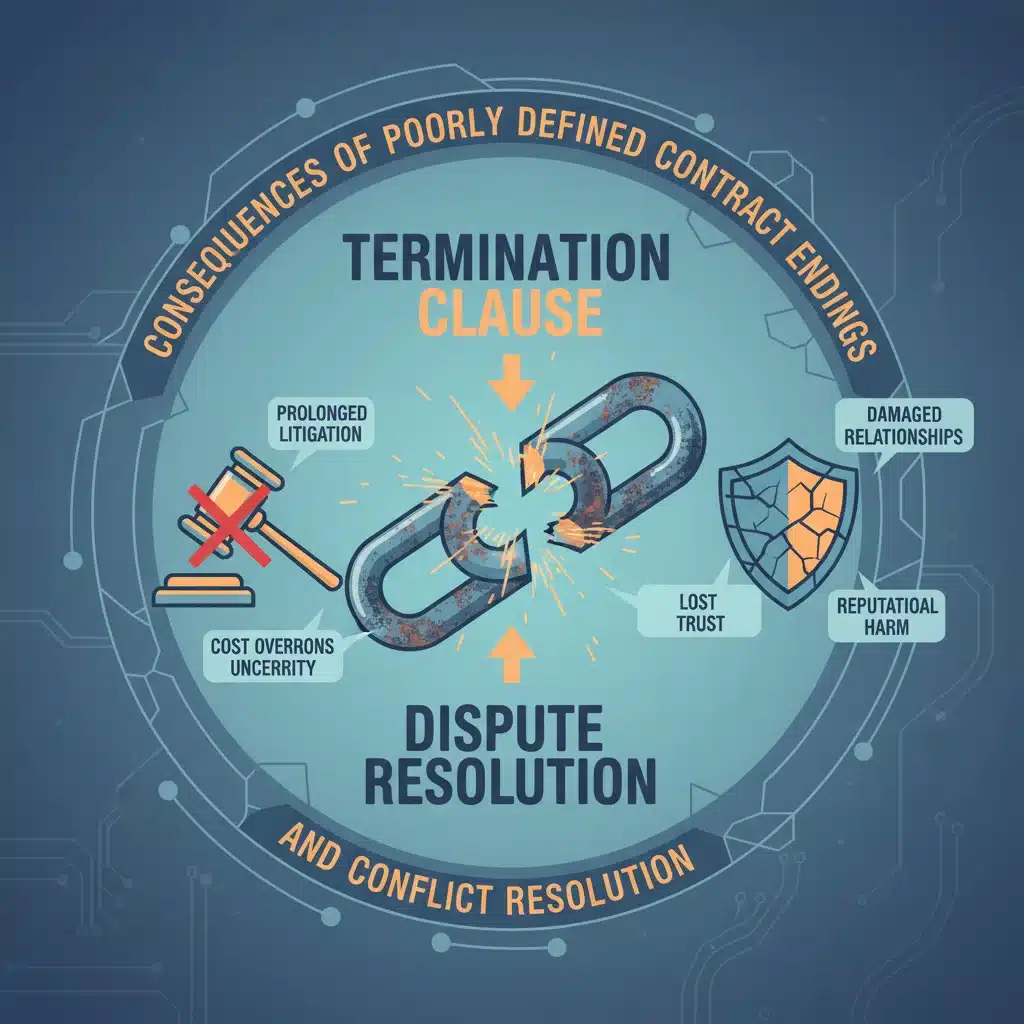
7. Dispute Resolution: Planning for Disagreements
No one enters into an agreement expecting conflict, but it’s prudent to have a plan in place for when disagreements inevitably arise. The ‘Dispute Resolution’ clause outlines the process for resolving conflicts between the parties without necessarily resorting to costly and time-consuming litigation. This is one of the most strategic service agreement clauses.
What to look for:
- Negotiation: Often, the first step is informal negotiation between the parties to try and resolve the issue directly.
- Mediation: If direct negotiation fails, mediation involves a neutral third party (the mediator) who facilitates discussions and helps the parties reach a mutually agreeable solution. Mediation is non-binding.
- Arbitration: Arbitration involves submitting the dispute to one or more neutral arbitrators who hear arguments and evidence and then render a binding decision (an award). Arbitration is typically less formal and faster than litigation but is usually binding, meaning parties waive their right to go to court.
- Litigation: If all else fails, the clause might specify that disputes will be resolved through litigation in a particular court.
- Governing Law: Which jurisdiction’s laws will govern the interpretation and enforcement of the agreement? This is crucial, especially in cross-border agreements.
- Jurisdiction/Venue: If litigation is specified, in which specific court or geographic location will legal action be pursued?
- Attorneys’ Fees: Does the clause specify who pays attorneys’ fees if a dispute goes to court or arbitration? (e.g., ‘the prevailing party shall be entitled to recover its reasonable attorneys’ fees’).
A well-crafted dispute resolution clause can save both parties significant time, money, and stress by providing a structured and efficient path to resolving conflicts. It’s a proactive measure that strengthens the integrity of all service agreement clauses.
The Importance of Legal Review: Don’t Go It Alone
While this article provides a detailed overview of crucial service agreement clauses, it’s important to reiterate that this information is for educational purposes only and does not constitute legal advice. Service agreements can be complex, and their implications can vary significantly based on jurisdiction, industry, and the specific nature of the services. Therefore, it is always highly recommended to have any significant service agreement reviewed by a qualified legal professional before signing.
A lawyer can identify hidden risks, negotiate favorable terms on your behalf, and ensure that the agreement aligns with your business objectives and legal obligations. They can also help you understand how these service agreement clauses interact with each other and with applicable laws.
Conclusion: Empowering Your Business with Knowledge
Service agreements are more than just formalities; they are critical legal instruments that define the parameters of your business relationships. By diligently scrutinizing these seven crucial service agreement clauses – Scope of Services, Payment Terms and Schedule, Term and Termination, Intellectual Property Rights, Confidentiality and Non-Disclosure, Indemnification and Limitation of Liability, and Dispute Resolution – you empower yourself to enter into agreements with clarity and confidence. Understanding these elements allows you to manage risks, protect your assets, ensure fair compensation, and foster successful, long-term partnerships.
Never underestimate the power of a well-understood contract. The time and effort invested in reviewing these service agreement clauses upfront will invariably save you from potential headaches, financial losses, and legal battles in the future. Approach every service agreement not just as a document to be signed, but as a strategic tool to safeguard your business interests and pave the way for mutual success.