Navigating 2026 Federal Student Loan Interest Rates: A Guide

Anúncios
Understanding the 2026 federal student loan interest rate forecast is crucial for current and prospective borrowers to plan their finances effectively and minimize the burden of educational debt.
For millions of Americans, student loans represent a significant financial commitment, and staying informed about their future trajectory is paramount. This guide provides a comprehensive look into federal student loans 2026, offering insights into projected interest rates and practical strategies for managing educational debt. Navigating the complexities of student loan interest rates can feel daunting, but with the right information, borrowers can make informed decisions and prepare for what lies ahead.
The mechanics of federal student loan interest rates
Federal student loan interest rates are not arbitrarily set; they are determined by a formula established by Congress, typically tied to the 10-year Treasury note auction. This mechanism ensures a degree of predictability, yet it remains susceptible to broader economic forces. Understanding this foundational principle is the first step in forecasting future rates and preparing for their impact on your financial landscape.
Anúncios
The rate for federal student loans is generally fixed for the life of the loan once it is disbursed. This means the rate you receive when you take out your loan will not change. However, Congress sets new rates for loans disbursed in subsequent academic years. This annual adjustment is what borrowers need to monitor closely, especially as we approach 2026.
How rates are determined
The process involves a statutory formula that adds a certain percentage to the high yield of the 10-year Treasury note. Different loan types, such as Direct Subsidized, Direct Unsubsidized, and PLUS loans, each have their own add-on percentages. These percentages are fixed by law, but the Treasury yield fluctuates based on market conditions, which in turn causes the student loan interest rates to vary annually.
- Direct Subsidized Loans: Often have the lowest rates, primarily for undergraduate students with financial need.
- Direct Unsubsidized Loans: Available to both undergraduate and graduate students, regardless of financial need.
- Direct PLUS Loans: For graduate or professional students and parents of dependent undergraduate students; typically carry higher interest rates.
The annual cycle of rate setting occurs each spring, with new rates becoming effective for loans disbursed from July 1st of that year through June 30th of the following year. Therefore, the rates for the 2025-2026 academic year will be announced in spring 2025. This timeline is critical for students and parents planning their educational financing.
Anúncios
In conclusion, the mechanics behind federal student loan interest rates are rooted in a combination of congressional mandates and market-driven Treasury yields. This structured approach, while providing some stability, necessitates ongoing vigilance from borrowers to anticipate changes and adapt their financial strategies accordingly.
Key economic indicators influencing 2026 rates
Forecasting federal student loan interest rates for 2026 requires a keen eye on several pivotal economic indicators. These factors collectively shape the broader economic environment, which in turn influences the 10-year Treasury note yield—the bedrock of federal student loan rates. Understanding these indicators provides a more nuanced perspective on potential future rate movements.
The Federal Reserve’s monetary policy, particularly changes to the federal funds rate, plays a significant role. When the Fed raises interest rates to combat inflation, it generally leads to higher yields on Treasury notes. Conversely, rate cuts typically result in lower yields. This cause-and-effect relationship is a primary driver of the cost of borrowing across the economy, including for student loans.
Inflation and monetary policy
Inflationary pressures often prompt the Federal Reserve to tighten monetary policy, which means increasing the federal funds rate. This action aims to cool down the economy and bring inflation under control. A higher federal funds rate makes borrowing more expensive for banks, and these costs are then passed on to consumers and reflected in bond yields, including the 10-year Treasury note.
- Federal Funds Rate: The target rate set by the Federal Reserve for overnight lending between banks.
- Quantitative Tightening: The Fed’s policy of reducing its balance sheet, which can also push up long-term interest rates.
- Market Expectations: Investor expectations about future inflation and Fed actions can influence current Treasury yields.
Beyond the Federal Reserve, global economic stability and geopolitical events can also impact Treasury yields. During times of uncertainty, investors often flock to safe-haven assets like U.S. Treasury bonds, which can drive down yields. Conversely, periods of strong economic growth and stability might see yields rise as investors seek higher returns elsewhere.
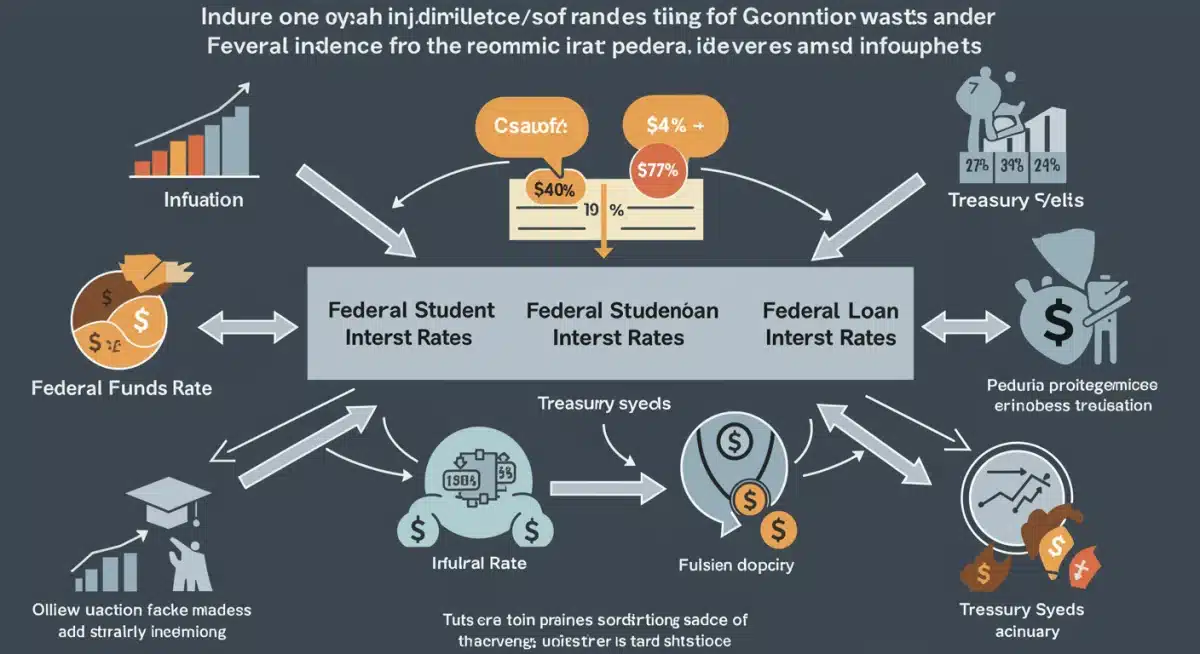
In summary, predicting 2026 rates involves monitoring a complex interplay of domestic and international economic forces. Inflation, the Federal Reserve’s stance on monetary policy, and broader market sentiment are all critical pieces of the puzzle that will ultimately determine the cost of new federal student loans.
Historical trends and future projections
Examining historical trends in federal student loan interest rates offers valuable context for understanding potential future movements. Over the past few decades, these rates have fluctuated significantly, influenced by shifts in economic policy, inflation, and market demand for Treasury securities. Analyzing these patterns can help us make more informed projections for 2026.
Historically, periods of economic expansion and higher inflation have often coincided with rising interest rates, while recessions or periods of low inflation have typically seen rates decline. However, the unique fixed-rate nature of federal student loans, once disbursed, means that borrowers are insulated from mid-loan rate changes. The focus, therefore, remains on the rates set for new loans each academic year.
Recent rate movements
In recent years, we’ve witnessed a period of relatively low interest rates, followed by a more upward trend as the Federal Reserve began to combat inflation. This recent tightening cycle has pushed up yields on the 10-year Treasury note, consequently increasing the cost of new federal student loans. The trajectory of these rates into 2026 will largely depend on whether these inflationary pressures persist or subside.
- Post-pandemic era: Initially low rates due to economic stimulus, followed by increases as inflation surged.
- Federal Reserve actions: Aggressive rate hikes to control inflation have been a dominant factor.
- Market stability: The overall stability of financial markets also plays a role in Treasury yields.
Looking ahead to 2026, many economists anticipate that the Federal Reserve’s actions will have a more settled effect on inflation. If inflation moderates towards the Fed’s target, there might be less pressure for further significant rate hikes, potentially leading to a stabilization or even a slight decrease in Treasury yields. However, unforeseen economic shocks or persistent inflation could alter this outlook considerably.
Ultimately, while historical data provides a framework, future projections for federal student loans 2026 are inherently speculative. They depend heavily on the evolution of macroeconomic conditions and policy responses, making continuous monitoring essential for all stakeholders.
Potential impact on borrowers and repayment strategies
Changes in federal student loan interest rates, particularly for loans disbursed in 2026, can significantly impact borrowers’ financial well-being and necessitate adjustments to repayment strategies. Even a seemingly small percentage point difference can translate into thousands of dollars over the lifetime of a loan, affecting monthly payments and overall financial flexibility.
For new borrowers entering higher education in 2026, higher interest rates mean a greater total cost of education. This could influence decisions about the amount of debt to take on, the type of degree pursued, or even the choice of institution. Understanding this potential impact allows prospective students to plan more prudently.
Adapting to higher rates
If interest rates for 2026 are higher than current levels, borrowers will need to consider several proactive strategies to mitigate the increased cost. Early repayment, if financially feasible, can significantly reduce the total interest paid. Exploring income-driven repayment (IDR) plans might also become more attractive, as these plans adjust monthly payments based on income and family size, providing a safety net for those with lower earnings.
- Aggressive Repayment: Paying more than the minimum can save substantial interest over time.
- Income-Driven Repayment (IDR): Offers lower monthly payments, potentially leading to forgiveness after 20 or 25 years.
- Loan Consolidation: Can simplify repayment by combining multiple federal loans into one, though it might not always lower interest rates.
Existing borrowers with fixed-rate federal loans are generally unaffected by new rates in 2026, as their rates are locked in. However, they might still benefit from reviewing their repayment plans, especially if their financial situation has changed. Refinancing federal loans into private loans is another option, but it comes with the significant caveat of losing federal protections like IDR plans and deferment options.
In conclusion, the potential impact of 2026 interest rates on borrowers underscores the importance of informed decision-making and strategic planning. Whether you are a new student or an existing borrower, understanding your options and adapting your repayment approach can help manage the financial burden effectively.
Government policies and future legislation
Government policies and potential future legislation play a crucial role in shaping the landscape of federal student loans, including their interest rates and repayment terms. While the formula for setting annual interest rates is statutory, Congress can amend this formula or introduce new policies that significantly alter the cost and accessibility of student aid. Keeping an eye on legislative developments is therefore essential for anticipating changes in 2026 and beyond.
The political climate and prevailing economic philosophies often dictate the legislative agenda concerning education finance. For instance, discussions around student loan forgiveness, refinancing options, and adjustments to repayment plans are ongoing. Any major legislative action in these areas could indirectly or directly affect the overall burden of student debt, even if the core interest rate formula remains unchanged.
Recent legislative discussions
In recent years, there have been numerous proposals aimed at reforming the federal student loan system. These discussions range from simplifying the application process to expanding eligibility for Pell Grants and modifying the terms of loan forgiveness programs. While direct changes to the interest rate formula are less frequently debated, broader reforms could still influence borrowing behavior and the perceived cost of loans.
- Loan Forgiveness Programs: Expansions or modifications to programs like Public Service Loan Forgiveness (PSLF) could reduce the overall debt burden for many.
- Pell Grant Increases: Enhanced grant funding could reduce the need for some students to borrow, thereby lessening their exposure to interest rates.
- Repayment Plan Reforms: Changes to IDR plans, making them more generous or easier to access, could provide greater financial relief.
Moreover, the Department of Education, under executive authority, can implement regulatory changes that impact various aspects of federal student loans. These administrative actions, while not requiring congressional approval, can still have a profound effect on borrowers, from servicing standards to the implementation of new repayment options. Therefore, staying informed about both legislative proposals and regulatory changes is vital.
Ultimately, the future of federal student loans 2026 will not only be determined by economic indicators but also by the political will and legislative priorities of the government. Borrowers should remain attentive to policy debates and potential reforms that could reshape their financial obligations.
Strategies for managing student loan debt effectively
Effectively managing student loan debt, especially in an environment of potentially fluctuating interest rates, requires a proactive and informed approach. Developing a robust strategy can help minimize the total cost of your loans and ensure financial stability throughout your repayment journey. This involves understanding your loan terms, exploring available options, and making deliberate financial choices.
One of the most fundamental strategies is to understand the specifics of your loans: interest rates, repayment start dates, and available deferment or forbearance options. Knowledge is power when it comes to debt management. Knowing these details allows you to create a personalized repayment plan that aligns with your financial goals and current income.
Proactive repayment tactics
For those with federal student loans, several strategies can help manage the debt effectively. Prioritizing payments on loans with higher interest rates, if you have multiple loans, can save you money in the long run. Even small additional payments can significantly reduce the principal balance and the total interest accrued over the loan’s life.
- Autopay Enrollment: Many servicers offer a slight interest rate reduction (typically 0.25%) for enrolling in automatic payments, which also helps avoid missed payments.
- Extra Payments: Any amount paid over the minimum can be directed towards the principal, reducing future interest.
- Bi-weekly Payments: Paying half your monthly payment every two weeks results in an extra payment per year, accelerating repayment.
Exploring income-driven repayment (IDR) plans is another critical strategy, especially if your income is modest compared to your debt. These plans cap your monthly payments at an affordable percentage of your discretionary income and offer potential loan forgiveness after a certain period. While they may extend the repayment term, they provide a crucial safety net for borrowers facing financial hardship.
For those considering refinancing, it’s essential to weigh the pros and cons carefully. Private refinancing can sometimes offer a lower interest rate, especially for borrowers with excellent credit, but it means forfeiting the unique protections and benefits of federal loans. Therefore, this decision should be made with a full understanding of the trade-offs involved.
In conclusion, managing federal student loans 2026 effectively is about more than just making monthly payments. It involves continuous education, strategic planning, and adapting your approach as your financial situation and the economic landscape evolve. By leveraging available tools and being proactive, borrowers can navigate their student loan journey with greater confidence and control.
| Key Point | Brief Description |
|---|---|
| Rate Determination | Federal student loan rates are set annually by Congress, tied to the 10-year Treasury note yield. |
| Economic Influences | Inflation, Federal Reserve policies, and global stability significantly impact Treasury yields and thus loan rates. |
| Borrower Impact | Higher rates increase total loan cost, affecting new borrowers and requiring strategic repayment planning. |
| Management Strategies | Utilize IDR plans, make extra payments, and consider autopay to effectively manage student loan debt. |
Frequently asked questions about 2026 federal student loan rates
Federal student loan interest rates for 2026 will be determined by a statutory formula. This formula adds a fixed percentage to the high yield of the 10-year Treasury note auction held in late spring 2025. These rates will apply to loans disbursed from July 1, 2025, through June 30, 2026.
No, your existing federal student loan interest rate will not change in 2026. Federal student loans have fixed interest rates once they are disbursed. The rates announced for 2026 will only apply to new loans taken out for the 2025-2026 academic year.
Key economic factors include inflation, the Federal Reserve’s monetary policy (like the federal funds rate), and the overall stability of the U.S. and global economies. These elements directly affect the 10-year Treasury note yield, which is the basis for setting student loan rates.
For existing federal loans, the rate is fixed. For new loans, you cannot directly lower the set rate. However, you might consider private refinancing, but this means losing federal benefits. Enrolling in autopay for federal loans can offer a small interest rate reduction.
Stay informed about economic forecasts and legislative updates. For prospective borrowers, budget carefully and borrow only what’s necessary. For current borrowers, review repayment options like income-driven plans and consider making extra payments if financially feasible to reduce total interest.
Conclusion
Navigating the complex world of federal student loan interest rates requires continuous vigilance and proactive planning. As we look towards 2026, understanding the underlying mechanics of rate determination, the influence of key economic indicators, and potential governmental policies becomes paramount. While future rates remain subject to economic shifts, borrowers can empower themselves by staying informed, exploring strategic repayment options, and adapting their financial approaches. By doing so, the burden of educational debt can be managed more effectively, allowing individuals to focus on their academic and professional aspirations with greater financial confidence.