Debt Snowball vs. Avalanche: Which Method Saves You More in 2026?
In the quest for financial freedom, one of the most critical hurdles many individuals face is managing and ultimately eliminating debt. As we navigate through 2026, the landscape of personal finance continues to evolve, making effective debt payoff strategies more crucial than ever. Two prominent methods, the debt snowball and the debt avalanche, consistently emerge as popular choices for tackling outstanding balances. But which one is truly superior? Which method will save you more money and help you achieve debt-free status faster in the coming year? This comprehensive guide will dissect both approaches, providing you with the insights needed to make an informed decision tailored to your financial situation.
Understanding the Debt Snowball Method
The debt snowball method is a debt reduction strategy where you pay off debts in order from smallest balance to largest. The core principle behind this method is psychological. By paying off smaller debts first, you gain momentum and a sense of accomplishment, which can be highly motivating to continue your debt-free journey.
How the Debt Snowball Works: A Step-by-Step Guide
- List All Your Debts: Start by listing all your debts, from credit cards and personal loans to car loans and student loans, excluding your mortgage for now.
- Order by Smallest Balance: Arrange these debts from the smallest outstanding balance to the largest, regardless of the interest rate.
- Make Minimum Payments: Pay the minimum required payment on all your debts except for the one with the smallest balance.
- Attack the Smallest Debt: Devote all extra money you can find in your budget to paying off the debt with the smallest balance.
- Roll the Payment: Once the smallest debt is paid off, take the money you were paying on that debt (the minimum payment plus the extra amount) and add it to the minimum payment of the next smallest debt. This creates a larger payment, like a snowball rolling downhill, gaining size and speed.
- Repeat: Continue this process until all your debts are paid off.
Pros of the Debt Snowball Method
- Psychological Boost: This is arguably the biggest advantage. Paying off debts quickly, even small ones, provides tangible wins that can keep you motivated and committed to your plan. This psychological reinforcement is invaluable, especially when facing a long and arduous debt repayment journey. Many people struggle with the discipline required for long-term financial goals, and these small victories can be the difference between success and failure. The feeling of seeing a debt disappear, even if it’s a small one, can be incredibly empowering and fuel your determination to tackle the next one.
- Increased Momentum: As each debt is eliminated, the amount you’re able to put towards the next debt grows, creating a powerful sense of momentum. This ‘snowball effect’ can make the process feel less overwhelming and more achievable over time.
- Simplicity: The method is straightforward and easy to understand, making it accessible for anyone, regardless of their financial literacy level. There’s no complex calculation of interest rates; just focus on the balance.
- Building Habits: Successfully paying off smaller debts helps build positive financial habits, such as budgeting, disciplined spending, and consistent debt payments. These habits are crucial for long-term financial health, even after all debts are cleared.
Cons of the Debt Snowball Method
- Potentially More Interest Paid: Because this method prioritizes balance size over interest rates, you might end up paying more in interest over the long run. If your smallest debt has a low interest rate while your largest debt carries a high interest rate, you’ll be paying off the low-interest debt first, allowing the high-interest debt to accrue more interest. This is a significant consideration for those with substantial high-interest debts.
- Slower Financial Savings: While it offers psychological benefits, the debt snowball method is not mathematically the most efficient way to save money. The focus is on quick wins, not on minimizing total interest paid.
- Longer Overall Repayment Time (Potentially): Depending on the distribution of your debts and their interest rates, it could take longer to become completely debt-free compared to a method that targets high-interest debts first. This can be demotivating if the initial psychological boost wears off and the total time to freedom seems extended.
Understanding the Debt Avalanche Method
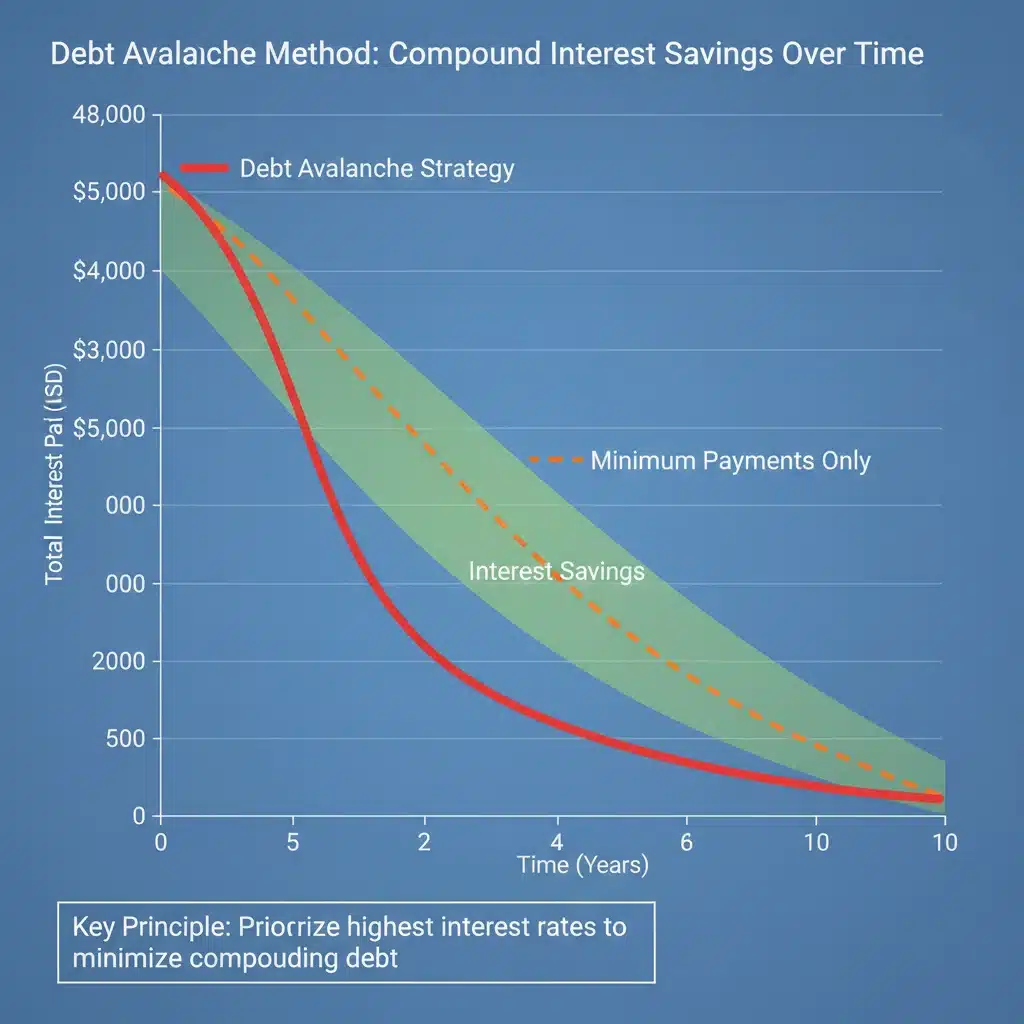
In contrast to the debt snowball, the debt avalanche method is a debt reduction strategy that prioritizes paying off debts with the highest interest rates first. This method is mathematically the most efficient way to pay off debt, as it minimizes the total amount of interest you’ll pay over the life of your debts.
Anúncios
How the Debt Avalanche Works: A Step-by-Step Guide
- List All Your Debts: Similar to the snowball method, list all your debts, excluding your mortgage for now.
- Order by Highest Interest Rate: Arrange these debts from the highest annual percentage rate (APR) to the lowest.
- Make Minimum Payments: Pay the minimum required payment on all your debts except for the one with the highest interest rate.
- Attack the Highest Interest Debt: Direct all extra money you can find in your budget towards paying off the debt with the highest interest rate.
- Roll the Payment: Once the highest interest debt is paid off, take the money you were paying on that debt (the minimum payment plus the extra amount) and add it to the minimum payment of the next highest interest debt.
- Repeat: Continue this process until all your debts are paid off.
Pros of the Debt Avalanche Method
- Maximum Interest Savings: This is the primary advantage of the debt avalanche. By targeting the debts that cost you the most money in interest first, you significantly reduce the total amount you pay over time. This can translate into thousands of dollars in savings, especially for those with high-interest credit card debt.
- Fastest Path to Debt-Free (Financially): Mathematically, the debt avalanche method will get you out of debt faster than the snowball method, assuming you maintain consistent extra payments. This is because you are eliminating the most expensive debts first, which frees up more money for subsequent payments more quickly.
- Greater Financial Efficiency: This method is ideal for individuals who are highly motivated by financial optimization and want to see the most significant impact on their bottom line. It’s a logical and analytical approach to debt repayment.
- Clear Financial Goal: The objective of minimizing interest is a powerful motivator for those who are driven by numbers and long-term financial benefits. Seeing the total interest paid decrease can be a significant motivator.

Cons of the Debt Avalanche Method
- Less Immediate Gratification: If your highest interest debt is also your largest debt, it might take a considerable amount of time before you pay it off. This lack of immediate ‘wins’ can be demotivating for some individuals, making it harder to stick to the plan. The psychological boost of seeing a debt disappear is delayed, which can lead to frustration or burnout.
- Requires Strong Discipline: Because the rewards are often delayed, the debt avalanche method demands a higher level of self-discipline and commitment. You need to be able to stay focused on the long-term financial gain without the frequent psychological boosts provided by the snowball method.
- Can Feel Overwhelming: For those with significant high-interest debt, the prospect of tackling a large balance first can feel daunting and overwhelming, potentially leading to a loss of motivation.
Debt Snowball vs. Avalanche: Which is Right for You in 2026?
The choice between the debt snowball and debt avalanche methods ultimately depends on your personal financial psychology and current situation. There’s no one-size-fits-all answer, and what works for one person might not work for another.
Consider the Debt Snowball If:
- You need a motivational boost: If you’ve struggled with debt repayment in the past or feel overwhelmed by the sheer number of debts, the quick wins of the debt snowball can provide the necessary motivation to keep going.
- You’re new to budgeting and debt management: The simplicity and immediate gratification can help you build good financial habits and confidence.
- Your smallest debts have relatively high-interest rates: In some cases, your smallest debts might also have high interest rates, making the snowball method coincidentally efficient in those specific instances.
- Your debt load feels unmanageable: Breaking down a large debt burden into smaller, achievable goals can make the entire process less intimidating.
Consider the Debt Avalanche If:
- You are highly disciplined and motivated by numbers: If you can stick to a plan even without immediate rewards and are driven by the idea of saving the most money, the avalanche method is for you.
- You have significant high-interest debt (e.g., credit cards): The more high-interest debt you have, the more you stand to save with the debt avalanche method. This is where the financial efficiency truly shines.
- You want to be debt-free in the shortest possible time, financially speaking: If your primary goal is to minimize total interest paid and achieve debt freedom in the most mathematically efficient way, the avalanche method is the clear winner.
- You have a stable income and emergency fund: Having a solid financial foundation can make it easier to weather the longer initial payoff period of a large, high-interest debt without losing motivation.
Hybrid Approaches and Other Considerations for 2026
It’s also important to remember that these aren’t the only two debt payoff strategies, nor are they mutually exclusive. You might find success by combining elements of both or by considering other factors in 2026’s financial climate.
The Hybrid Method
Some individuals find success by starting with a few small snowball payments to build momentum, then transitioning to the avalanche method once they’ve gained confidence. This ‘hybrid’ approach can offer the best of both worlds: initial psychological wins followed by long-term financial optimization.
Interest Rates and Economic Outlook in 2026
As we look to 2026, interest rates can fluctuate. Keeping an eye on prevailing interest rates, especially for variable-rate debts, can influence your strategy. If interest rates are projected to rise, tackling high-interest debts becomes even more critical. Conversely, if rates are stable or falling, the mathematical advantage of the avalanche method might be slightly less pronounced, though still present.
Debt Consolidation and Refinancing
Before even applying either the snowball or avalanche method, consider if debt consolidation or refinancing is an option. Consolidating multiple high-interest debts into a single loan with a lower interest rate can significantly reduce your overall interest payments and simplify your monthly budgeting. Similarly, refinancing a high-interest loan (like a personal loan or even student loan) can provide a better rate and terms, making either the snowball or avalanche method even more effective.
Emergency Fund First
Regardless of the debt repayment method you choose, it’s generally advisable to have a small emergency fund (e.g., $1,000 or one month’s expenses) saved up before aggressively tackling debt. This fund acts as a buffer against unexpected expenses, preventing you from incurring new debt if an emergency arises. Building this initial safety net can provide peace of mind and prevent setbacks in your debt-free journey.
Case Studies: Snowball vs. Avalanche in Action
To further illustrate the impact of these debt payoff strategies, let’s consider two hypothetical scenarios for 2026.
Anúncios
Scenario 1: The Snowball Success Story
Meet Sarah, who has four debts:
- Credit Card A: $500 (18% APR)
- Personal Loan B: $2,000 (10% APR)
- Credit Card C: $3,000 (22% APR)
- Car Loan D: $10,000 (6% APR)
Sarah has an extra $200 per month to put towards her debt. Using the debt snowball method, she would tackle Credit Card A first. Once that’s paid off, she’d roll the payment into Personal Loan B, and so on. The quick win of paying off Credit Card A (in just a few months) gives her immense motivation. She feels empowered and sticks to her plan, even though Credit Card C has a much higher interest rate. The psychological boost is exactly what she needed to stay consistent.
Scenario 2: The Avalanche Achiever
John has the same debts as Sarah, but he’s a numbers person and highly disciplined:
- Credit Card A: $500 (18% APR)
- Personal Loan B: $2,000 (10% APR)
- Credit Card C: $3,000 (22% APR)
- Car Loan D: $10,000 (6% APR)
John also has an extra $200 per month. He chooses the debt avalanche method, prioritizing Credit Card C (22% APR). It takes him longer to pay off this initial, higher-interest debt, but he knows he’s saving the most money in the long run. He tracks his interest savings diligently, which serves as his primary motivator. Over the entire repayment period, John will pay significantly less in total interest than Sarah.
Tools and Resources for Debt Management in 2026
Regardless of which of the debt payoff strategies you choose, several tools and resources can help you stay on track in 2026:
- Budgeting Apps: Apps like YNAB (You Need A Budget), Mint, or Personal Capital can help you track your spending, identify areas to cut back, and ensure you have extra money to put towards debt.
- Debt Payoff Calculators: Many free online calculators allow you to input your debts and compare how long it will take and how much interest you’ll pay using both the snowball and avalanche methods. This can be an eye-opening exercise and help you visualize the financial impact of each strategy.
- Financial Advisors/Credit Counselors: If your debt situation is complex, or you feel overwhelmed, consider consulting a certified financial advisor or a non-profit credit counseling agency. They can provide personalized advice and help you create a sustainable debt repayment plan.
- Automated Payments: Setting up automatic minimum payments ensures you never miss a due date, protecting your credit score. For your extra payments, consider setting up a recurring transfer to your target debt to maintain consistency.
- Debt Management Plans (DMPs): For those struggling with overwhelming credit card debt, a DMP through a credit counseling agency can consolidate payments and often reduce interest rates. This is a more formal approach and can be a lifeline for many.
Beyond Debt Repayment: Building a Secure Financial Future
While paying off debt is a crucial step, it’s just one part of building a secure financial future. Once you’re debt-free, or even while you’re working towards it, consider these additional steps:
- Build a Robust Emergency Fund: Aim for 3-6 months (or even more) of living expenses in a high-yield savings account. This provides a strong financial safety net.
- Invest for Retirement: Start contributing to a 401(k) or IRA, especially if your employer offers a match. Compounding interest is your best friend when it comes to long-term wealth building.
- Save for Other Goals: Whether it’s a down payment on a house, a child’s education, or a dream vacation, set specific savings goals and create a plan to achieve them.
- Continue Budgeting and Tracking: Maintain the good financial habits you developed during your debt repayment journey. Regular budgeting and monitoring your finances are essential for long-term success.
- Increase Your Income: Explore opportunities to boost your earnings, whether through a side hustle, negotiating a raise, or investing in new skills. More income provides greater flexibility for saving and investing.
Conclusion: Making Your Choice for 2026
Both the debt snowball and debt avalanche methods are effective debt payoff strategies, but they cater to different psychological and financial needs. The debt snowball offers powerful psychological wins, making it ideal for those who need motivation to stay on track. The debt avalanche, on the other hand, is mathematically superior, saving you the most money in interest over time. As you plan your financial strategy for 2026, carefully consider your personality, your debt profile, and what will keep you most engaged and committed to the process.
Ultimately, the ‘best’ method is the one you stick with. Whether you choose the immediate gratification of the snowball or the long-term financial efficiency of the avalanche, consistency and discipline are your greatest allies on the path to becoming debt-free. By understanding these powerful debt payoff strategies and aligning them with your personal financial psychology, you can confidently navigate your way to a more secure and prosperous 2026 and beyond.