Child Tax Credit 2026: What Families Need to Know for Future Benefits

Anúncios
Child Tax Credit 2026: What Families Need to Know for Future Benefits
The Child Tax Credit (CTC) has long been a cornerstone of financial support for American families, playing a crucial role in alleviating child poverty and boosting household incomes. As we look ahead to 2026 and beyond, significant changes are on the horizon that could redefine the scope and impact of this vital credit. Understanding these potential shifts is not just about staying informed; it’s about empowering your family to plan effectively and maximize the benefits available.
The landscape of tax legislation is constantly evolving, and the CTC is no exception. With temporary expansions having expired and new legislative debates emerging, the future structure of the Child Tax Credit 2026 is a topic of intense discussion among policymakers, economists, and families across the nation. This comprehensive guide will delve into the historical context of the CTC, examine the recent legislative proposals, explore the potential implications for various family structures, and provide practical advice on how to prepare for these upcoming changes.
Whether you’re a parent, guardian, or simply interested in the future of family financial policy, this article aims to provide a clear, in-depth analysis of what the Child Tax Credit 2026 could mean for you. We’ll break down the complexities, offer insights into eligibility, and help you navigate the path to securing your family’s financial well-being in the years to come.
Anúncios
Understanding the Child Tax Credit: A Historical Perspective
To truly grasp the significance of the Child Tax Credit 2026, it’s essential to understand its origins and evolution. The CTC was first introduced in 1997 as part of the Taxpayer Relief Act, initially providing a non-refundable credit of $400 per child. Its primary goal was to offer tax relief to middle-income families, helping to offset the costs associated with raising children.
Over the years, the CTC has undergone several modifications, each aiming to broaden its reach and increase its impact. Key milestones include:
- 2001 Tax Act: Increased the credit amount to $1,000 per child and made it partially refundable, meaning low-income families who owed less in taxes than the credit amount could still receive a portion of it as a refund.
- 2009 American Recovery and Reinvestment Act: Lowered the earnings threshold for refundability, making the credit accessible to even more low-income families during the Great Recession.
- 2017 Tax Cuts and Jobs Act (TCJA): Significantly expanded the CTC, doubling it from $1,000 to $2,000 per qualifying child. It also introduced a non-refundable credit of $500 for other dependents and increased the refundable portion to $1,400 per child, indexed for inflation. The TCJA also raised the income phase-out thresholds, allowing more higher-income families to qualify. However, many provisions of the TCJA, including these CTC changes, are set to expire at the end of 2025, setting the stage for the crucial discussions around the Child Tax Credit 2026.
- 2021 American Rescue Plan (ARP): This was perhaps the most transformative, albeit temporary, expansion of the CTC. For one year, the credit increased to $3,600 for children under six and $3,000 for children aged six to seventeen. Crucially, it became fully refundable, meaning even families with no earned income could receive the full benefit. The ARP also allowed for advance monthly payments, providing immediate financial relief to millions of families. This temporary expansion had a profound impact, significantly reducing child poverty rates. However, these enhanced benefits expired at the end of 2021, reverting the credit to its TCJA levels for subsequent tax years.
The journey of the CTC reflects a continuous effort to balance financial relief for families with budgetary considerations. Each iteration has brought new debates about eligibility, refundability, and the overall economic impact. The upcoming discussions for the Child Tax Credit 2026 are poised to revisit many of these fundamental questions, with the 2021 expansion serving as a powerful case study for what a fully refundable, more generous credit can achieve.
Anúncios
The Current State of the Child Tax Credit (Pre-2026)
Before we dive into the potential future, let’s clarify the Child Tax Credit as it stands currently, for tax years 2022-2025, under the provisions of the 2017 Tax Cuts and Jobs Act (TCJA) and the expiration of the American Rescue Plan’s enhancements.
For these years, the maximum credit per qualifying child is $2,000. Of this amount, up to $1,600 (for 2023, indexed for inflation) is refundable as the Additional Child Tax Credit (ACTC) for families with lower incomes. To qualify for the refundable portion, families must have earned income above $2,500. The credit begins to phase out for single filers with a modified adjusted gross income (MAGI) exceeding $200,000, and for married couples filing jointly with a MAGI exceeding $400,000.
Key characteristics of the current CTC:
- Credit Amount: Up to $2,000 per qualifying child.
- Refundability: Up to $1,600 (for 2023) is refundable through the ACTC.
- Earned Income Threshold: Families must have earned income of at least $2,500 to qualify for the refundable portion.
- Age Limit: The child must be under age 17 at the end of the tax year.
- Income Phase-Outs: High-income earners see the credit reduced.
It’s crucial for families to understand these current rules as they prepare their taxes for the coming years leading up to 2026. While the $2,000 credit offers significant relief, the limitations on full refundability and the earned income threshold mean that the lowest-income families may not receive the full benefit, a key point of contention in ongoing legislative debates.
What’s Driving the Discussion for Child Tax Credit 2026?
The impending expiration of the 2017 TCJA provisions at the end of 2025 is the primary catalyst for the widespread discussion surrounding the Child Tax Credit 2026. This expiration means that without new legislation, the CTC would revert to its pre-TCJA structure, which would be a substantial reduction for many families. This looming deadline has created an urgent need for Congress to act, leading to various proposals and intense negotiations.
Several factors are influencing these discussions:
- Expiration of TCJA Provisions: The automatic reversion to older, less generous CTC rules would significantly impact millions of families, potentially pushing many children back into poverty. This is a major concern for advocates and lawmakers.
- Impact of the 2021 ARP Expansion: The temporary full refundability and increased credit amounts in 2021 demonstrated a powerful reduction in child poverty. This success has fueled calls for a permanent return to a more generous, fully refundable credit. Data from organizations like the Census Bureau and Columbia University’s Center on Poverty and Social Policy highlighted the dramatic decrease in child poverty during the ARP’s implementation, providing strong evidence for its effectiveness.
- Economic Conditions: Ongoing economic challenges, including inflation and the rising cost of living, make financial assistance for families even more critical. Policymakers are looking for ways to provide relief and stimulate economic growth.
- Political Dynamics: The CTC has become a highly politicized issue, with different parties and factions proposing varying approaches. There’s broad bipartisan support for some form of child tax credit, but the details—such as credit amount, refundability, and work requirements—are points of significant disagreement.
- Focus on Work Requirements: One of the central debates revolves around work requirements. Some lawmakers advocate for maintaining or strengthening the earned income threshold, arguing it encourages work. Others contend that a fully refundable credit, without a strict work requirement, is essential to reach the poorest families and effectively combat child poverty.
- Administrative Simplicity: The advance monthly payments under the ARP also sparked discussions about the administrative feasibility and benefits of providing regular, predictable income support to families, rather than a lump sum tax refund.
These intersecting factors create a complex legislative environment, making the exact form of the Child Tax Credit 2026 difficult to predict. However, the stakes are incredibly high for families nationwide.
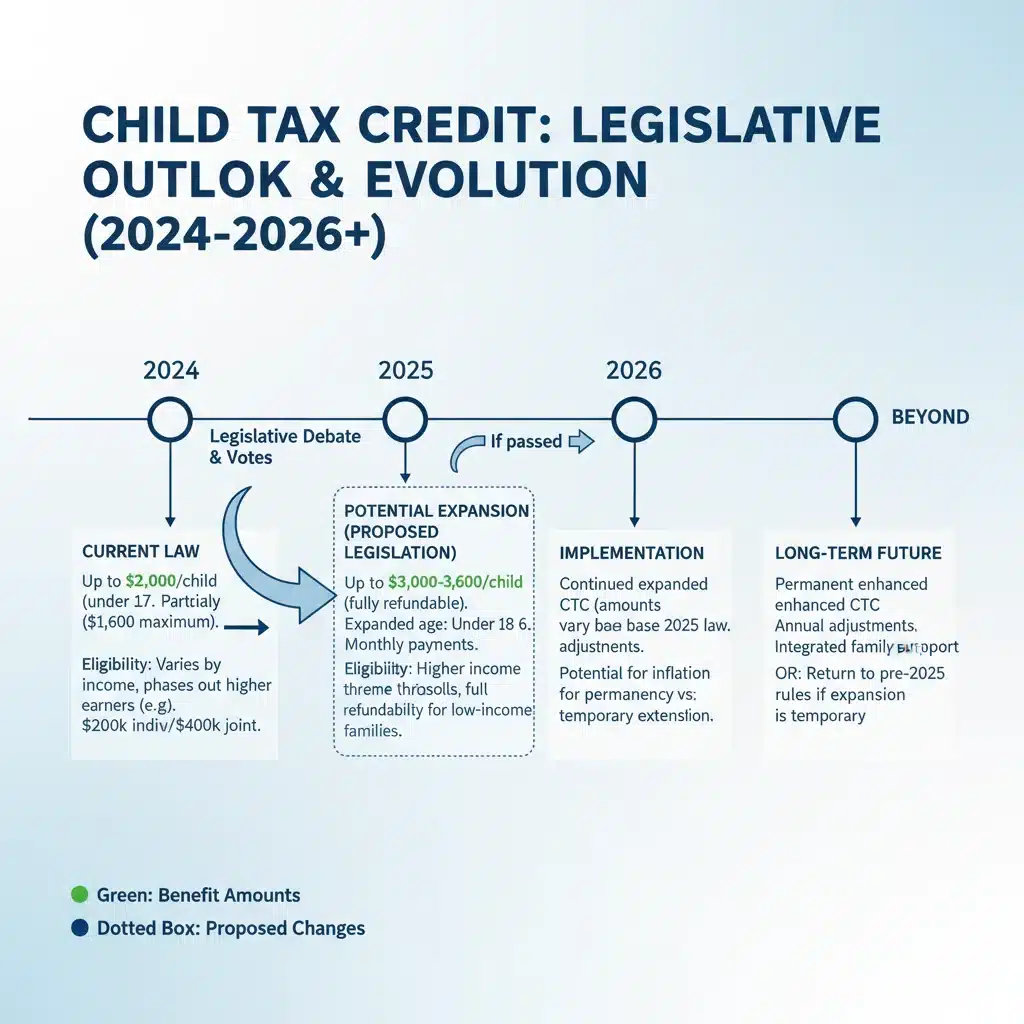
Key Legislative Proposals and Potential Changes for Child Tax Credit 2026
As we approach 2026, several proposals are circulating in Congress, each with different implications for the Child Tax Credit. Understanding these proposals is key to anticipating the future landscape.
1. Bipartisan Tax Framework (Earlier 2024 Proposal)
A notable bipartisan proposal emerged in early 2024, aiming to enhance the Child Tax Credit while also addressing business tax deductions. Key elements of this framework included:
- Increased Refundability: This proposal aimed to expand the refundable portion of the CTC, allowing more low-income families to access a greater share of the credit. Instead of being tied solely to tax liability, it would allow families to receive a larger refund even if their tax liability was low.
- Inflation Adjustment: The refundable portion of the credit would be indexed for inflation, ensuring its value doesn’t erode over time.
- Look-back Provision: This provision would allow families to use their prior year’s income to calculate the refundable portion of the CTC if their current year’s income was lower, providing stability for families experiencing income fluctuations.
- No Change to Max Credit: The maximum credit amount per child ($2,000) would generally remain unchanged, rather than reverting to pre-TCJA levels or matching the ARP’s higher amounts.
- Business Tax Breaks: The CTC enhancements were paired with several business tax breaks, such as immediate expensing for research and development, and a return to 100% bonus depreciation. This coupling was intended to garner bipartisan support.
While this framework passed the House, its fate in the Senate remains uncertain, and it represents just one potential path forward. It reflects a compromise that seeks to expand benefits for lower-income families without fully adopting the broad, fully refundable model of the 2021 ARP.
2. Proposals for a Fully Refundable CTC (Similar to ARP)
Many progressive lawmakers and child advocates continue to push for a return to a fully refundable Child Tax Credit, similar to the 2021 American Rescue Plan expansion. These proposals typically advocate for:
- Higher Credit Amounts: Often proposing $3,000 or $3,600 per child, aligning with the ARP.
- Full Refundability: Eliminating the earned income threshold, ensuring that the lowest-income families, including those with no taxable income, receive the full benefit. This is seen as the most effective way to combat child poverty.
- Advance Monthly Payments: Reinstating the option for families to receive the credit in monthly installments, providing consistent financial support throughout the year.
- Lower Age Thresholds: Some proposals also suggest maintaining the higher credit for younger children.
The primary argument for this approach is its proven effectiveness in reducing child poverty, especially among the most vulnerable populations. However, concerns about the cost and the perceived lack of work incentives often hinder its passage.
3. More Conservative Approaches
Other proposals tend to be more conservative, focusing on maintaining or strengthening the link between the Child Tax Credit and work. These might involve:
- Retaining or Increasing Earned Income Thresholds: Emphasizing that the credit should primarily benefit working families.
- Lower Credit Amounts: Reverting to pre-TCJA levels or offering smaller increases than other proposals.
- Focus on Non-Refundable Credits: Prioritizing the credit as a tax liability reducer rather than a direct income support for those with no tax liability.
These proposals often prioritize fiscal responsibility and the belief that tax benefits should be tied to economic participation.
The final form of the Child Tax Credit 2026 will likely be a result of intense negotiation and compromise between these various viewpoints. Families should monitor legislative developments closely, as even small changes can have significant impacts.
Implications for Families: Who Benefits Most from the Child Tax Credit 2026?
The specific design of the Child Tax Credit 2026 will determine which families benefit most and by how much. However, we can analyze the potential implications based on the types of changes being discussed.
If a Bipartisan Compromise Prevails (e.g., similar to early 2024 proposal):
- Low- and Moderate-Income Families: These families would likely see the most significant gains. The expansion of refundability means that more of the credit would be accessible to them, even if their tax liability is low. The inflation adjustment would help maintain the credit’s purchasing power.
- Families with Fluctuating Incomes: The look-back provision for income would be particularly beneficial for families experiencing job loss, reduced hours, or other income instability, providing a safety net.
- Middle-Income Families: These families, who already largely qualify for the $2,000 credit, would continue to receive substantial support, helping to offset the costs of raising children.
- High-Income Families: Families above the existing phase-out thresholds would likely see no change or minimal impact, as proposals generally focus on enhancing benefits for lower and middle-income brackets.
If a Fully Refundable CTC is Reinstated (similar to 2021 ARP):
- The Poorest Families: This group would experience the most dramatic positive impact. Eliminating the earned income threshold means that families with little to no earned income would receive the full credit, directly addressing child poverty. The 2021 ARP demonstrated a significant reduction in poverty rates for these families.
- Single-Parent Households: Often disproportionately affected by poverty, these families would see substantial financial relief.
- Families with Younger Children: If the higher credit for children under six is reintroduced, families with infants and toddlers would receive additional support during crucial developmental years.
- All Families with Children: Even middle and higher-income families would benefit from increased credit amounts, though the percentage increase in their overall income might be less dramatic than for lower-income households.
If No Action is Taken (Reversion to Pre-TCJA Law):
- Significant Loss for Many Families: The credit would revert to $1,000 per child, with stricter refundability rules and lower income phase-outs. This would result in a substantial reduction in benefits for a vast number of families across all income levels except the very highest.
- Increased Child Poverty: Economists predict that a reversion would lead to a significant increase in child poverty rates, undoing much of the progress made since 2017.
- Hardest Hit: Low- and moderate-income families who currently receive the $2,000 credit and some refundable portion would be hit hardest by this reduction.
The stakes for the Child Tax Credit 2026 are incredibly high, with the potential to either significantly boost family well-being or revert to a less supportive system. Families should pay close attention to legislative updates to understand how these changes might specifically affect their household budget and financial planning.

Preparing Your Family for the Child Tax Credit 2026
Regardless of the specific outcome, there are proactive steps families can take now to prepare for potential changes to the Child Tax Credit 2026. Being prepared ensures you can adapt quickly and maximize any benefits available.
1. Stay Informed and Monitor Legislative News
The most crucial step is to keep abreast of legislative developments. Follow reputable news sources, financial planning websites, and government announcements regarding tax policy. Organizations focused on family advocacy and poverty reduction often provide excellent summaries and analyses of proposed changes to the Child Tax Credit.
- Subscribe to updates: Many financial news outlets and government agencies offer newsletters or alerts on tax policy changes.
- Consult official sources: The IRS website is the ultimate authority for tax information. Regularly check for updates as 2025 draws to a close and new legislation is considered.
2. Understand Your Current Eligibility and Benefits
Before you can plan for the future, you need a clear picture of your present situation. Review your tax returns from recent years to understand how the current CTC rules apply to your family.
- Know your MAGI: Your Modified Adjusted Gross Income is critical for determining eligibility and phase-outs.
- Verify your dependents: Ensure all eligible children are properly claimed as dependents and meet the age and residency requirements.
- Keep accurate records: Maintain meticulous records of income, expenses, and family changes (births, adoptions, etc.) that could affect your tax situation.
3. Adjust Your Financial Planning and Budgeting
Anticipate potential changes in your tax refund or tax liability. If the CTC becomes more generous, you might expect a larger refund or lower tax bill. If it reverts to less generous terms, be prepared for a smaller benefit.
- Scenario planning: Consider different scenarios for the Child Tax Credit 2026 (e.g., full refundability, partial refundability, or reversion) and how each would impact your household budget.
- Emergency fund: Continue building or maintaining an emergency fund. This financial cushion can help absorb any unexpected shifts in tax benefits or other financial circumstances.
- Adjust withholdings: Once new legislation is passed and you understand its impact, you may need to adjust your W-4 form with your employer to ensure the correct amount of tax is withheld from your paycheck. This can help prevent a large tax bill or a significantly smaller refund than anticipated.
4. Seek Professional Advice
Tax laws can be complex, and changes can make them even more so. Consulting with a qualified tax professional or financial advisor can provide personalized guidance.
- Tax Preparers: A Certified Public Accountant (CPA) or Enrolled Agent (EA) can help you understand how the new CTC rules apply specifically to your family’s unique situation.
- Financial Planners: A financial planner can help you integrate potential CTC changes into your broader financial strategy, including savings, investments, and long-term goals.
5. Advocate for Your Interests
If you feel strongly about a particular direction for the Child Tax Credit 2026, consider contacting your elected officials. Lawmakers often consider constituent feedback when drafting and voting on legislation.
By taking these proactive steps, families can navigate the evolving landscape of the Child Tax Credit 2026 with greater confidence and ensure they are well-positioned to benefit from whatever changes come their way.
Beyond 2026: The Long-Term Outlook for the Child Tax Credit
While the immediate focus is on the Child Tax Credit 2026, the discussions around its future extend far beyond that year. The debates surrounding the CTC reflect fundamental disagreements about the role of government in supporting families, the balance between work incentives and poverty reduction, and the overall structure of the U.S. tax code.
One of the key long-term considerations is the sustainability of various proposals. A fully refundable, expanded CTC, while highly effective at reducing poverty, comes with a significant price tag. Lawmakers will continue to grapple with how to fund such initiatives without adding excessively to the national debt or requiring substantial tax increases elsewhere.
Another ongoing debate centers on the definition of a ‘qualifying child’ and potential adjustments to age limits or other criteria. There are also discussions about whether the credit should be more explicitly tied to specific expenses, such as childcare costs, or remain a broader income support.
The political will to establish a permanent and stable Child Tax Credit that addresses both economic realities and social goals is paramount. The temporary nature of past expansions has created uncertainty for families and made long-term financial planning challenging. A more predictable and consistent CTC would allow families to better plan for their children’s education, healthcare, and overall well-being.
Furthermore, the effectiveness of the CTC in reducing poverty and improving child outcomes will continue to be a subject of research and analysis. Data from the 2021 expansion provides compelling evidence, and ongoing studies will inform future policy decisions. As the economic landscape shifts and societal needs evolve, the Child Tax Credit will likely remain a dynamic area of tax policy, subject to adjustments and reforms in the years to come.
Families, advocates, and policymakers will need to continue engaging in thoughtful discussions to ensure the Child Tax Credit remains a powerful tool for supporting children and strengthening communities for generations to come. The decisions made regarding the Child Tax Credit 2026 will not only shape the immediate financial future of millions but also set a precedent for the long-term commitment to family well-being in the United States.
Conclusion
The Child Tax Credit 2026 stands as a pivotal moment for American families. With the expiration of the 2017 tax law provisions looming, the future of this critical financial support is in active debate, with potential outcomes ranging from a significant expansion to a substantial reduction in benefits. The discussions are driven by a complex interplay of historical precedents, the proven impact of past expansions, current economic conditions, and diverse political ideologies.
Understanding the current state of the CTC, the various legislative proposals, and their implications for different income brackets is essential for effective family financial planning. Whether Congress opts for a bipartisan compromise, a return to a fully refundable model, or allows for a reversion to pre-TCJA rules, each scenario carries distinct consequences for household budgets and child poverty rates.
By staying informed, reviewing your financial situation, adjusting your budget, and seeking professional advice when needed, your family can proactively prepare for these upcoming changes. The Child Tax Credit has a profound impact on the lives of millions of children and their families, and the decisions made regarding the Child Tax Credit 2026 will shape the economic well-being of the nation for years to come. Your engagement and awareness are key to navigating this evolving landscape and ensuring your family is best positioned for the future.