Maximize Social Security Benefits 2026: Expert Strategies

Anúncios
Maximize Your Social Security Benefits: Essential Strategies for 2026 Claimants
As you approach retirement, understanding and optimizing your Social Security benefits becomes one of the most critical financial decisions you’ll make. For those planning to claim Social Security in 2026, the landscape presents unique opportunities and challenges. Navigating the rules, understanding the claiming ages, and implementing strategic approaches can significantly impact your retirement income for decades to come. This comprehensive guide is designed to equip you with the knowledge and actionable strategies to maximize your Social Security 2026 benefits.
Social Security isn’t just a government handout; it’s a foundational component of most Americans’ retirement plans. The decisions you make regarding when and how to claim your benefits can mean the difference of tens, or even hundreds, of thousands of dollars over your lifetime. With potential adjustments to cost-of-living allowances (COLAs), changes in the economy, and the ever-present discussion around the solvency of the Social Security trust funds, staying informed is paramount. Let’s delve into the crucial aspects of maximizing your benefits for 2026.
Understanding the Basics of Social Security for 2026
Before we dive into advanced strategies, it’s essential to grasp the fundamental principles of Social Security, particularly as they apply to those claiming in 2026. Your Social Security benefit amount is primarily determined by your highest 35 years of earnings, adjusted for inflation. The more you’ve earned (up to the annual earnings limit) and the longer you’ve worked, the higher your Primary Insurance Amount (PIA) will be. The PIA is the benefit you would receive if you claim at your Full Retirement Age (FRA).
Anúncios
Full Retirement Age (FRA) for 2026 Claimants
Your Full Retirement Age (FRA) is a pivotal factor in determining your benefit amount. For individuals born in 1960 or later, the FRA is 67. If you were born in 1959, your FRA is 66 and 10 months. Understanding your specific FRA is crucial because claiming benefits before or after this age will result in a permanent adjustment to your monthly payment.
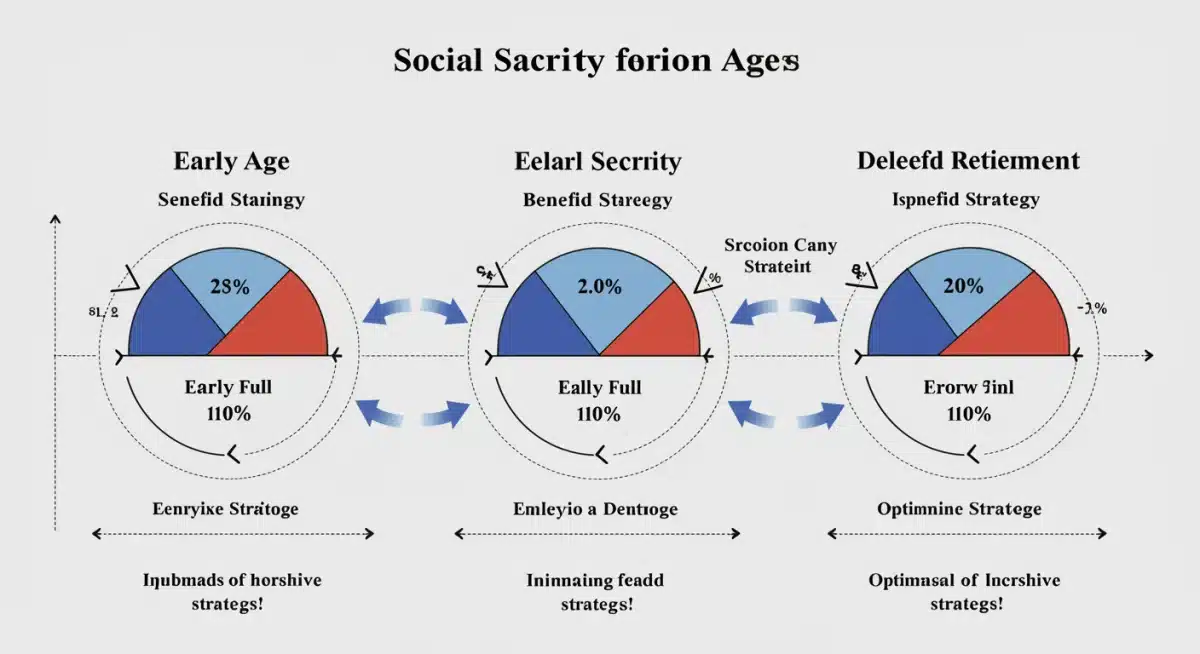
- Early Retirement: You can start receiving Social Security benefits as early as age 62. However, claiming early will result in a reduced monthly benefit, as you will receive benefits for a longer period. The reduction can be as much as 30% if you claim at age 62 and your FRA is 67.
- Full Retirement Age: Claiming at your FRA means you receive 100% of your PIA. This is the baseline from which early or delayed claiming adjustments are made.
- Delayed Retirement: For every year you delay claiming benefits past your FRA, up to age 70, you earn an 8% increase in your annual benefit. These are known as Delayed Retirement Credits (DRCs). This can lead to a significantly higher monthly payment.
For those targeting Social Security 2026, knowing your FRA is the first step in formulating a claiming strategy. It’s not just about when you can claim, but when it’s most advantageous for your financial situation.
Cost-of-Living Adjustments (COLAs) and Their Impact
Each year, Social Security benefits are subject to a Cost-of-Living Adjustment (COLA) to help maintain their purchasing power against inflation. While the exact COLA for 2026 won’t be announced until late 2025, it’s an important factor to consider. A higher COLA can mean a more substantial increase in your monthly benefit. These adjustments apply to all beneficiaries, regardless of when they started claiming, but the percentage increase is applied to your current benefit amount. Therefore, a higher initial benefit (achieved through delayed claiming, for example) will result in a larger dollar increase from any COLA.
Anúncios
Strategy 1: Maximizing Benefits Through Delayed Claiming
One of the most powerful strategies to maximize your Social Security 2026 benefits is to delay claiming past your Full Retirement Age. As mentioned, for every year you delay beyond your FRA, up to age 70, you earn Delayed Retirement Credits (DRCs) that increase your annual benefit by 8%. This is a guaranteed, inflation-adjusted return that is difficult to match in other low-risk investments.
The Power of Delayed Retirement Credits
Let’s illustrate the impact of DRCs. If your FRA is 67 and your PIA is $2,000 per month, here’s how delaying can affect your benefit:
- Claiming at FRA (67): $2,000 per month
- Claiming at 68: $2,000 + (8% of $2,000) = $2,160 per month
- Claiming at 69: $2,160 + (8% of $2,000) = $2,320 per month (approximately)
- Claiming at 70: $2,320 + (8% of $2,000) = $2,480 per month (approximately)
By delaying until age 70, you could increase your monthly benefit by 24% compared to claiming at your FRA. Over a long retirement, this can add up to hundreds of thousands of dollars. This strategy is particularly attractive for individuals who are in good health, have sufficient other retirement savings to live on, or plan to continue working past their FRA.
When Delayed Claiming Makes Sense
While delaying is often recommended, it’s not a one-size-fits-all solution. Consider these factors:
- Health and Longevity: If you expect to live a long life, delaying benefits offers a greater cumulative payout. If your health is poor, early claiming might be more beneficial.
- Other Income Sources: If you have substantial other retirement savings (e.g., 401(k), IRA, pension) or continue to work, you might not need to rely on Social Security in your early retirement years, making delayed claiming feasible.
- Spousal Benefits: In some cases, delaying your own benefits might also increase survivor benefits for your spouse. We’ll explore this further.
- Opportunity Cost: Consider what you would do with the money if you claimed early. Could you invest it to achieve a higher, guaranteed, and inflation-protected return than 8% per year? Probably not without significant risk.
The decision to delay should be part of a holistic retirement plan, taking into account your personal circumstances, financial needs, and health outlook. For those planning to optimize their Social Security 2026 benefits, this strategy is often at the forefront.
Strategy 2: Navigating Spousal and Survivor Benefits
Social Security benefits extend beyond individual earnings. Spousal and survivor benefits offer critical financial protection for families. Understanding these rules is crucial for married couples, divorcees, and widows/widowers planning for Social Security 2026.
Spousal Benefits: A Key for Married Couples
If you are married, you may be eligible to receive spousal benefits based on your spouse’s earnings record. A spouse can receive up to 50% of the higher-earning spouse’s Primary Insurance Amount (PIA) if they claim at their own FRA. However, you can only claim spousal benefits once your spouse has filed for their own benefits.
Here are key considerations for spousal benefits:
- Claiming Age: Like individual benefits, spousal benefits are reduced if claimed before your own FRA and do not accrue delayed retirement credits past your FRA.
- Your Own Work Record: If you are eligible for benefits based on your own work record and for spousal benefits, the Social Security Administration (SSA) will pay you your own benefit first. If your spousal benefit is higher, they will pay you the difference. You generally cannot collect both in full.
- Restricted Application (No Longer Available for Most): For those born before January 2, 1954, there was a strategy called ‘Restricted Application’ where you could claim only spousal benefits at your FRA, allowing your own benefit to grow until age 70. This option is generally no longer available for those claiming in 2026, as it was phased out for those born after January 1, 1954.
Married couples should coordinate their claiming strategies. Often, the higher earner delays claiming to maximize their own benefit (and subsequently, potential survivor benefits), while the lower earner might claim their own benefits earlier or a spousal benefit when advantageous. This coordination is vital for maximizing combined family benefits for Social Security 2026.

Survivor Benefits: Protecting Your Family’s Future
Survivor benefits provide a safety net for widows, widowers, and in some cases, dependent children. If your spouse passes away, you may be eligible for benefits based on their earnings record. A surviving spouse can receive 100% of the deceased spouse’s benefit amount if they claim at their own FRA, or a reduced amount if claimed earlier (as early as age 60, or 50 if disabled).
Important points about survivor benefits:
- Your Own Benefits vs. Survivor Benefits: You can switch between collecting your own earned benefits and survivor benefits. For example, you might claim the survivor benefit early and let your own benefit grow until age 70, then switch to your higher personal benefit. Or vice-versa. This flexibility is a powerful tool.
- Impact of Deceased Spouse’s Claiming Age: The amount of the survivor benefit is directly tied to what the deceased spouse was receiving or would have received. If the deceased spouse delayed claiming benefits, the survivor benefit will be higher. This reinforces the importance of delayed claiming for the higher earner in a couple.
- Remarriage: Generally, if you remarry before age 60 (or 50 if disabled), you cannot receive survivor benefits. If you remarry after age 60 (or 50 if disabled), your survivor benefits are usually unaffected.
For individuals planning their Social Security 2026 strategy, especially married couples, a thorough understanding of spousal and survivor benefits is essential for comprehensive financial protection.
Strategy 3: Working While Receiving Benefits and Taxation
Many individuals choose to continue working part-time or full-time even after they start receiving Social Security benefits. While this can provide additional income, it’s crucial to understand how working affects your benefits and the potential tax implications, especially when planning for Social Security 2026.
The Earnings Test: How Working Affects Benefits Before FRA
If you claim Social Security benefits before your Full Retirement Age (FRA) and continue to work, your benefits may be reduced if your earnings exceed certain annual limits. This is known as the ‘earnings test’.
- Before the Year You Reach FRA: For 2024 (the latest available data for illustrative purposes; 2026 limits will be announced later), if you are under FRA for the entire year, the SSA deducts $1 from your benefits for every $2 you earn above the annual limit ($22,320 in 2024).
- In the Year You Reach FRA: In the year you reach your FRA, a different earnings limit applies. For 2024, the SSA deducts $1 from your benefits for every $3 you earn above a higher annual limit ($59,520 in 2024), but only counting earnings before the month you reach FRA. Once you reach your FRA, the earnings test no longer applies.
It’s important to note that any benefits withheld due to the earnings test are not lost forever. When you reach your FRA, your monthly benefit will be recalculated to account for the months benefits were withheld, effectively increasing your future payments. However, the immediate reduction can be a surprise if not anticipated.
Once you reach your Full Retirement Age, the earnings test no longer applies, and you can earn as much as you want without any reduction in your Social Security benefits. This is a critical point for those planning their transition into retirement and considering when to claim their Social Security 2026 benefits.
Taxation of Social Security Benefits
Another important aspect of working while receiving benefits, or simply receiving benefits, is the potential for federal income tax. Depending on your ‘combined income’, a portion of your Social Security benefits may be taxable.
Combined income is calculated as your adjusted gross income (AGI) + nontaxable interest + one-half of your Social Security benefits.
- Up to 50% Taxable: If your combined income is between $25,000 and $34,000 for an individual, or between $32,000 and $44,000 for a married couple filing jointly, up to 50% of your Social Security benefits may be taxable.
- Up to 85% Taxable: If your combined income is more than $34,000 for an individual, or more than $44,000 for a married couple filing jointly, up to 85% of your Social Security benefits may be taxable.
These thresholds are not adjusted for inflation, meaning more and more beneficiaries find their benefits are subject to federal income tax over time. Some states also tax Social Security benefits, so it’s essential to check your state’s tax laws.
Understanding these tax implications is vital for holistic financial planning. A higher monthly benefit from delaying claiming could push you into a higher tax bracket, or make a larger portion of your benefits taxable. Conversely, strategizing other income sources can help manage your combined income. This is a complex area where professional financial advice can be invaluable for Social Security 2026 planning.
Additional Considerations for Social Security 2026 Claimants
Beyond the core strategies, several other factors can influence your Social Security benefits and overall retirement picture. Being aware of these can help refine your claiming strategy.
Reviewing Your Social Security Statement Annually
The Social Security Administration (SSA) provides an annual statement that summarizes your earnings history and estimated future benefits. You can access this statement online by creating an account at my Social Security. It’s crucial to review this statement regularly to ensure your earnings record is accurate. Errors can lead to lower benefits, and correcting them can take time. For anyone planning their Social Security 2026 benefits, this is a non-negotiable step.
Understanding the "File and Suspend" Strategy (Past Tense)
Previously, a strategy known as "File and Suspend" allowed individuals to file for benefits at their FRA, immediately suspend them, and then accrue Delayed Retirement Credits while their spouse collected spousal benefits. This strategy was largely eliminated by the Bipartisan Budget Act of 2015 for those born after January 1, 1954. If you are planning for Social Security 2026, this strategy is almost certainly not available to you. It’s a good example of how Social Security rules can change, emphasizing the need for up-to-date information.
The Role of Personal Health and Longevity
Your personal health and family history of longevity are significant factors in your claiming decision. If you anticipate a shorter lifespan due to health conditions, claiming earlier might provide a greater cumulative payout. Conversely, if you come from a family with a history of living into their 90s or beyond, delaying benefits to maximize your monthly payment can be a very wise move, acting as longevity insurance.
Coordinating with Other Retirement Income Streams
Social Security should not be viewed in isolation. It’s one piece of your overall retirement income puzzle. Consider how your Social Security claiming strategy integrates with your other retirement assets, such as 401(k)s, IRAs, pensions, and personal savings. For example, drawing down on tax-deferred accounts in your early retirement years to allow your Social Security benefits to grow can be a powerful strategy. This coordinated approach is essential for a robust Social Security 2026 plan.
Seeking Professional Advice
The rules governing Social Security are complex and can be overwhelming. Given the significant financial implications, consulting with a qualified financial advisor who specializes in retirement planning and Social Security can be incredibly beneficial. An advisor can help you analyze your specific situation, project different claiming scenarios, and develop a personalized strategy that aligns with your financial goals and life circumstances for Social Security 2026 and beyond.
Preparing for Your Social Security 2026 Claim
As you get closer to your claiming date in 2026, there are some practical steps you can take to ensure a smooth process and avoid potential pitfalls:
- Gather Your Documents: You’ll need documents like your birth certificate, Social Security card, and possibly marriage or divorce certificates. Having these ready in advance will streamline the application process.
- Create an Online Account: If you haven’t already, create a ‘my Social Security’ account on the SSA website. This allows you to view your earnings record, get benefit estimates, and apply for benefits online.
- Understand the Application Process: You can apply for benefits online, by phone, or in person at a Social Security office. Familiarize yourself with the process and allow ample time, as it can sometimes take a few weeks to finalize.
- Re-Evaluate Your Strategy: Life circumstances can change. Re-evaluate your claiming strategy periodically, especially in the year leading up to 2026, to ensure it still aligns with your needs and goals.
The decisions surrounding when and how to claim your Social Security 2026 benefits are among the most impactful financial choices you’ll make for your retirement. By understanding the rules, exploring various strategies, and considering your personal circumstances, you can significantly enhance your financial security in retirement. Don’t leave money on the table; take the time to plan thoughtfully and strategically.
Conclusion: Securing Your Financial Future with Social Security 2026
Maximizing your Social Security benefits for 2026 requires careful planning, a deep understanding of the regulations, and a strategic approach tailored to your unique situation. We’ve explored three core strategies: leveraging delayed claiming for higher monthly payments, understanding and utilizing spousal and survivor benefits for family protection, and navigating the complexities of working while receiving benefits and taxation.
The 8% annual increase from Delayed Retirement Credits offers an unparalleled, risk-free return on your investment in delaying benefits. For married couples, coordinating claiming strategies to optimize combined spousal and survivor benefits can secure a more robust financial future. Furthermore, being aware of the earnings test and the tax implications of your benefits is crucial for effective income management during retirement.
As you approach this significant milestone, remember to regularly review your Social Security statement, consider your health and longevity, and integrate your Social Security strategy with your overall retirement income plan. While the rules can be intricate, the effort invested in understanding and optimizing your Social Security 2026 benefits will undoubtedly pay dividends throughout your retirement years. Don’t hesitate to seek professional financial guidance to ensure you make the most informed decisions for your financial well-being.